Yes — for most people, the answer is yes, you can learn to sing.
That question comes up so often because singing feels personal. If your voice shakes, goes flat, or sounds nothing like you hoped, it’s easy to assume something is wrong with you. But in most cases, that’s not what’s happening at all. Most beginner struggles come from tension, lack of coordination, inconsistent practice, or just not knowing where to start. Those things can improve.
This article is here to make that feel simpler. We’re not going to make it complicated. We’ll talk honestly about what holds people back, whether “tone deafness” is really the issue, whether adults can still learn, and how to start in a way that actually feels doable.
Start here
A good first reminder is that progress usually comes from small, repeatable drills — not from trying to force your voice into sounding “good” right away.
If you want the full step-by-step framework behind this article, start with the How to Sing guide.
What beginners should know
Confidence is part of singing too
A lot of people asking can anyone learn to sing are not just asking about technique. They’re asking because they feel embarrassed, tense, or discouraged.
That matters more than people think.
When you’re nervous, you usually breathe too shallowly, your jaw tightens, your throat works harder, and your pitch gets less stable. Then you hear yourself struggle and assume you “just can’t sing.” In reality, your body is often getting in your way before your voice has even had a fair chance.
That’s why confidence is not separate from technique. It affects technique.
If you’ve ever thought, can I sing if my voice is bad, the answer is usually yes — because what sounds like a “bad voice” is often just an untrained voice under pressure. The goal at the beginning is not to sound amazing. The goal is to sing with enough ease that your voice can actually start learning. Once that happens, progress becomes much easier.
One of the best things you can do early on is make singing feel less dramatic. Practice in private. Use a normal volume, not a tiny whisper. Work in short sessions. The more normal singing starts to feel, the better your voice usually behaves.
“Tone deaf” is real, but it’s rare
A lot of people say “I’m tone deaf” when what they really mean is “I’m struggling.”
Those are not the same thing.
True congenital amusia — what people often call tone deafness — is real, but it’s uncommon. One large study found it affects about 1.5% of the population. That means the huge majority of people who think they are tone deaf are probably not. They are more likely dealing with lack of training, weak pitch matching skills, or low confidence.
That’s actually very good news.
It means that if singing feels difficult, the odds are strongly in your favor. You are probably not “broken.” You are probably just untrained. And being untrained is fixable.
People improve all the time by doing simple things:
- starting notes more cleanly,
- slowing exercises down,
- matching one note at a time,
- and repeating short patterns until the voice and ear begin to connect.
So if you’ve been assuming you have some permanent problem, it may help to replace that thought with a better one: maybe you just haven’t learned the skill yet.
Adults can learn to sing too
Another very common fear is age.
People ask:
- Is 25 too late to become a singer?
- Can adults learn to sing?
- Is it too late to learn singing?
The answer is no — it’s not too late.
Adults learn skills all the time. Singing is no different. It may feel intimidating because the voice is part of you, but it still works like a trainable skill. You are learning coordination: breathing, hearing, timing, pitch control, and vocal habits. Those can all improve at any age.
In fact, adults often have an advantage in one important area: they can be more consistent and intentional. If you decide to learn to sing as an adult, you’re often better at building routines, noticing patterns, and sticking with practice than you would have been years earlier.
So no, 25 is not too late. Neither is 35, 45, or older.
What matters more than age is whether you practice in a smart, repeatable way.
Why singing is learnable
You do not need a big scientific explanation to understand why singing can be learned.
In simple terms:
- your breath provides the air,
- your vocal folds create the sound,
- and your throat, mouth, and tongue shape that sound.
That means singing is not one magical talent. It’s a group of smaller skills working together.
And that is exactly why it can be trained.
If posture improves, your breath usually improves.
If your breath improves, your notes often feel steadier.
If your jaw and tongue relax, your tone often opens up.
If your ear gets better at hearing pitch, your singing gets more accurate.
You don’t have to fix everything at once. You just have to start improving one piece at a time.
That is also why warm-ups help so much. They don’t just “prepare” the voice in some vague way. They get the whole system moving more gently and efficiently. Exercises like lip trills, humming, and straw work are widely used because they help singers find easier coordination without forcing sound.
If you want the bigger picture behind all of this, the How to Sing guide lays it out step by step.
A practical starter plan
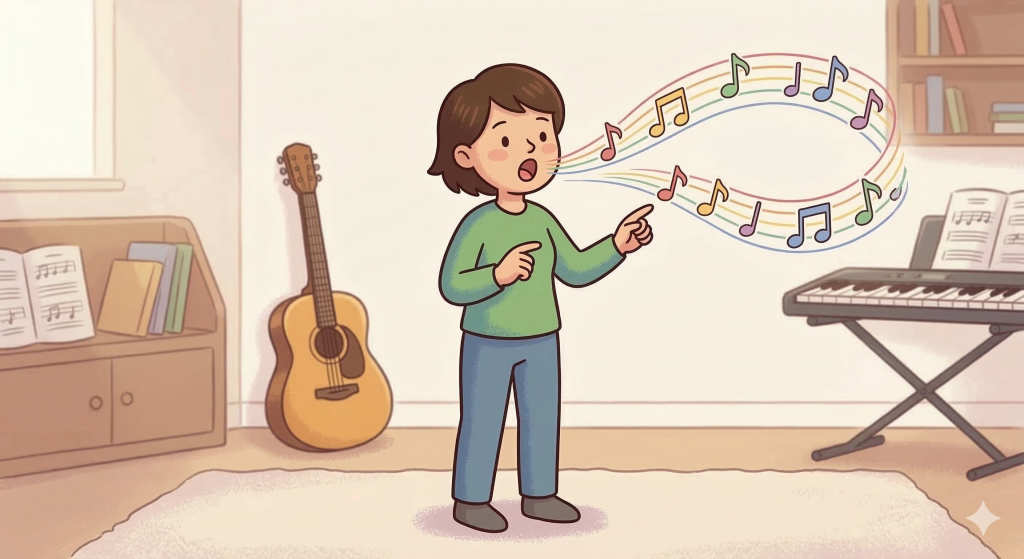
If you’re wondering how to start singing, the answer is not “wait until you feel confident.” Confidence usually comes after you start.
A simple routine is enough.
Try this: practice 10 to 25 minutes most days. That’s plenty for a beginner. It’s short enough that you can stay consistent, but long enough to build real coordination over time.
A calm way to begin each session
Start by standing comfortably. Let your knees stay soft. Drop your shoulders. Take one easy breath and say one sentence out loud in your normal speaking voice.
Then hum the pitch of the last word for two seconds.
Then gently open that hum into “ah.”
That tiny sequence helps your voice move from speaking into singing without suddenly tensing up. It also reminds you that singing is not separate from your natural voice — it grows out of it.
A very easy warm-up
Do a light lip trill for 20 seconds.
Then slide slowly from a comfortable low note to a middle note and back down. Keep it easy. If you have to push, you’re doing too much.
This kind of warm-up is often better than starting with full singing because it helps the voice feel flexible without pressure.
A five-minute pitch match
Pick one note in a comfortable middle part of your voice.
Sing “oo” on that note for two seconds, stop, and repeat several times.
Then try a small pattern like:
do – re – mi – re – do
Keep it slow. The point is not speed. The point is accuracy.
This is one of the best early exercises for how to sing for beginners, because it teaches your ear and your voice to line up.
Keep the routine simple
The easiest mistake beginners make is trying to do too much.
They sing too long, too loudly, or too inconsistently. Then they get tired, discouraged, and assume they’re not improving.
A much better strategy is this:
- do a short warm-up,
- do one small pitch exercise,
- sing one short section of a song,
- stop while the voice still feels comfortable.
That is enough.
What to do — and what not to do
It helps to think in terms of good habits rather than perfection.
Do:
- practice 10–25 minutes most days,
- sing at a clear, comfortable volume,
- stop before strain,
- repeat small drills often.
Don’t:
- save everything for one long session a week,
- whisper-sing to “hide,”
- push through pain,
- judge yourself too early.
Skills improve faster through repetition and recovery than through pressure.
This is one of the most important things to remember if you’re trying to figure out can you learn to sing: yes, but you need a system that lets you continue.
When to seek extra help
Most beginner issues are normal. Weak pitch, shaky tone, breathiness, tension, and inconsistency are all common at the start.
But some things should not be ignored.
If you have:
- hoarseness that doesn’t go away,
- pain while speaking or singing,
- sudden voice loss,
- or a voice that feels persistently strained,
it’s worth getting checked.
The NIDCD advises seeing a doctor if hoarseness lasts more than three weeks. They also list common warning signs such as raspy voice, throat pain, loss of high notes, and speaking effort.
That doesn’t mean something is seriously wrong. It just means you shouldn’t guess forever if the problem sticks around.
Conclusion
So, can anyone learn to sing?
For most people, yes.
Not because everyone will sound the same, and not because progress happens instantly, but because singing is a learnable skill. Most people who struggle at first are not failing because they lack talent. They are struggling because they have not yet trained the skill in a calm, repeatable way.
That is a much more hopeful place to start.
If you keep your sessions short, your expectations realistic, and your practice steady, your voice can improve more than you probably think right now.
For the full roadmap, go through the How to Sing guide.
FAQ
Can anyone learn to sing?
Yes. Most people can improve with consistent practice, feedback, and better coordination. Singing ability varies, but most beginners can make real progress over time.
Can I sing if my voice is bad?
Yes. In many cases, a “bad voice” simply means an untrained voice. With regular practice, better breathing, and simple pitch work, most people improve noticeably.
Is 25 too late to become a singer?
No. Adults can absolutely learn to sing. Age does not stop you from building better vocal habits and stronger coordination.
How to start singing?
Start with short, regular practice: a gentle warm-up, a simple pitch exercise, and one short song section. Keep it comfortable and repeat most days.