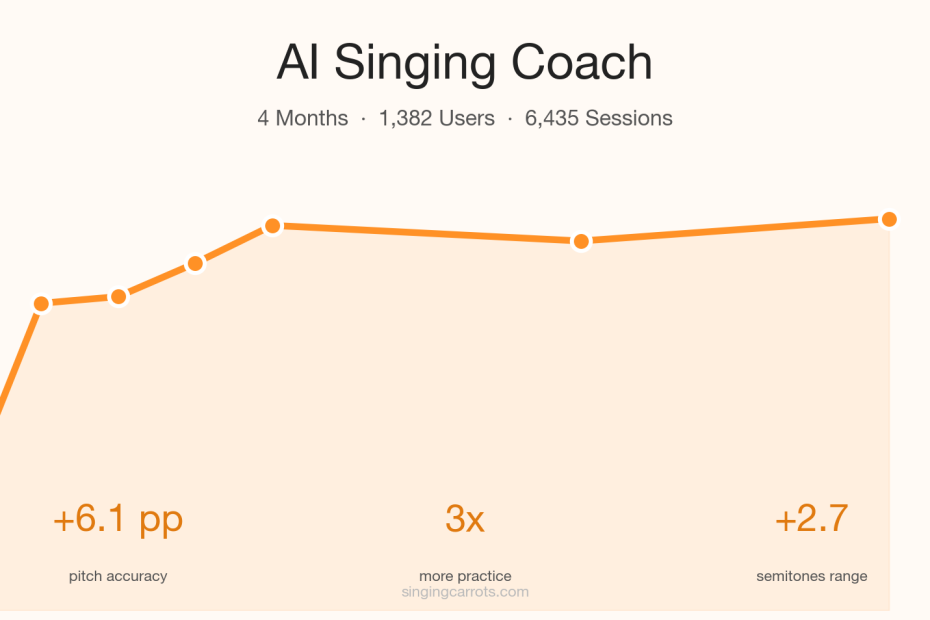
First results from Singing Carrots’ AI singing coach, launched November 2025. Data from 1,382 users, 6,435 coaching sessions, and 841,933 notes practiced.
Update (June 2026): We have since published a deeper analysis of 7 months of data – who improves most (beginners gained the most), whether the gains last, and what the coaching conversation adds.
Key findings: After 4 months of real-world use, singers using Singing Carrots’ AI singing coach improved their pitch accuracy by an average of 6.1 percentage points, expanded their vocal range by 2.7 semitones, and practiced 2.95 times more than self-guided users. 76.6% of tracked users measurably improved their pitch matching. The AI vocal coach received an average rating of 4.65 out of 5 stars across 1,268 reviews.
Singing lessons have always had an accessibility problem. A good vocal coach costs $60-150 per hour. Scheduling is inflexible. Many aspiring singers — especially adults picking it up for the first time — never start because the barrier feels too high.
In late November 2025, we launched an AI singing coach inside Singing Carrots. Not a chatbot that talks about singing. A real-time training partner that listens to you sing, analyzes your pitch, builds a personalized practice plan, and adapts on the fly — powered by large language models and our pitch detection engine.
Four months in, the data is back. Here’s what we found.
The Numbers at a Glance
| Metric | Value |
|---|---|
| Users who tried AI singing coach | 1,382 |
| Total coaching sessions | 6,435 |
| Sessions completed (not abandoned) | 92.4% |
| Total messages exchanged with coach | 166,636 |
| Notes practiced in AI mode | 841,933 |
| Avg. pitch accuracy improvement (4 weeks) | +6.1 percentage points |
| Avg. vocal range expansion | +2.7 semitones |
| Users who improved pitch accuracy | 76.6% |
| Average user rating | 4.65 / 5 |
| Users who rated 4 or 5 stars | 92.5% |
Does AI Vocal Coaching Actually Improve Singing? The Pitch Accuracy Data
The first question anyone asks about an AI singing coach: does it actually make you a better singer? We looked at two objective metrics our pitch detection engine captures — pitch accuracy (how precisely users match target notes) and vocal range (the span between their lowest and highest singable notes).

Pitch accuracy: +6.1 percentage points after 4 weeks
We tracked 214 users who had at least 20 note attempts in both their first week and after week 4 — the same individuals measured twice, which controls for the possibility that weaker users simply dropped out.
- Average first-week accuracy: 83.5%
- Average after 4 weeks: 89.7%
- Average improvement: +6.1 percentage points
- 76.6% of users improved their pitch accuracy; 23.4% stayed flat or declined
The variability also tightened — standard deviation dropped from 19.7% in week 0 to 6.9% by week 4. Users weren’t just getting better on average; they were getting more consistent.
The broader weekly curve across all users (not just the paired cohort) shows a similar pattern, though the raw numbers look more dramatic due to survivor bias — users who struggle are more likely to stop:
| Week | Users | Avg. Accuracy |
|---|---|---|
| Week 0 (first week) | 1,204 | 78.1% |
| Week 1 | 324 | 86.8% |
| Week 2 | 226 | 87.1% |
| Week 3 | 194 | 88.6% |
| Week 4 | 148 | 90.3% |
| Week 8 | 63 | 89.6% |
| Week 12 | 26 | 90.6% |
The biggest jump happens in the first week. By week 4, users plateau around 90% accuracy. This is consistent with what vocal pedagogy research predicts: early pitch matching improves rapidly with consistent feedback, then gains become incremental. We can’t say how much of this is the AI coaching versus simply practicing more regularly (see Limitations).
Vocal range expanded by 2.7 semitones on average

For 252 users with vocal range measurements at both the start and end of their AI coaching period:
- Average initial range: 27.4 semitones (~2.3 octaves)
- Average latest range: 30.1 semitones (~2.5 octaves)
- Average gain: +2.7 semitones
To put that in perspective, 2-3 semitones is roughly 2-3 additional singable notes at the top or bottom of your range. For a beginner, that can mean the difference between straining on a chorus and singing it comfortably.
The distribution of range changes:
| Change | Users | Share |
|---|---|---|
| Gained 7+ semitones | 69 | 27.4% |
| Gained 4-6 semitones | 42 | 16.7% |
| Gained 1-3 semitones | 52 | 20.6% |
| No change | 13 | 5.2% |
| Lost 1-3 semitones | 37 | 14.7% |
| Lost 4+ semitones | 39 | 15.5% |
64.7% of users expanded their vocal range. The 30% who lost range is a reminder that this metric is noisy — vocal range measurements are snapshots affected by fatigue, warm-up state, mic sensitivity, and time of day. We can’t rule out that some of the gains are measurement noise too. But with 252 users, the average direction is meaningful even if individual numbers aren’t precise.
More AI coaching sessions = more vocal range growth
Users who trained more with the AI singing coach tended to see bigger gains:
| Sessions Completed | Users | Avg. Range Change | % Who Expanded |
|---|---|---|---|
| 1-5 sessions | 103 | +0.9 semitones | 59% |
| 6-15 sessions | 88 | +3.8 semitones | 66% |
| 16-30 sessions | 45 | +4.0 semitones | 73% |
| 30+ sessions | 16 | +4.4 semitones | 69% |
Users who completed 6+ sessions gained roughly 4x the range of those who only did 1-5. This correlation between practice volume and range growth is consistent with what you’d expect — more practice, more improvement — though we can’t fully separate the effect of the coaching itself from the effect of simply singing more (see Limitations).
AI-Coached Singers Practice 3x More Than Self-Guided Users
We compared practice volume — actual notes sung and scored by our pitch detection engine — between AI-coached users and traditional self-guided users during the same time period (December 2025 onward).
| Mode | Users | Avg. Notes per User |
|---|---|---|
| AI singing coach mode | 1,218 | 691 |
| Traditional self-guided | 8,498 | 234 |
AI-coached singers practiced 2.95 times more than traditional users. This is a large gap, though it comes with a caveat: we can’t know how much of it is the coaching driving more practice versus more motivated users choosing the coaching mode in the first place. It’s likely some of both.
That said, the pattern makes intuitive sense. The AI singing coach creates structure — it sets a plan, gives real-time feedback, and knows when to push vs. when to pull back. It turns an open-ended “I should practice” into a guided session with clear goals. Like going to the gym with a trainer versus going alone, having a plan and accountability tends to mean you do more.
User Engagement and Retention
Sessions are deep, not superficial
Nearly two-thirds of all sessions (63%) hit the “power user” threshold of 20+ messages — meaning the singer and the AI coach had a real, extended training conversation. Another 26% reached 11-20 messages. Only about 5% of sessions were abandoned or ended after just a message or two.
The sessions are getting longer over time. Average messages per session grew from 15 in November to 30 by March. People aren’t just coming back — they’re going deeper.
Session engagement breakdown:
| Engagement Level | Sessions | Share |
|---|---|---|
| 20+ messages (power users) | 4,032 | 63% |
| 11-20 messages (engaged) | 1,676 | 26% |
| 5-10 messages (active) | 422 | 7% |
| 1-4 messages (short/exploring) | 305 | 5% |
Retention tells the real story
- 48% of users came back for a second session or more
- 29% completed 4+ sessions
- 16% completed 8+ sessions
- 27 users logged 30+ sessions each
- Our most dedicated singer completed 84 sessions over 98 days — roughly 6 sessions per week
For cross-month retention: 225 users were active across 2+ months, 85 across 3+ months, and 40 users have been training with the AI singing coach every single month since launch.
Growth trajectory
Monthly usage grew rapidly after launch:
| Month | Sessions | Unique Users | Completion Rate |
|---|---|---|---|
| Dec 2025 | 1,020 | 418 | 86% |
| Jan 2026 | 1,972 | 624 | 90% |
| Feb 2026 | 1,918 | 452 | 96% |
| Mar 2026* | 1,519 | 403 | 95% |
*March data through the 24th
January saw explosive growth — nearly doubling December. The completion rate climbed from 86% to a steady 95-96%, reflecting both product improvements and a maturing user base that knows what to expect.
Total notes practiced in AI mode tell a similar story: from 92K in December to 278K in February — a 3x increase in actual singing volume on the platform.
User Satisfaction: 4.65 / 5 Stars
Users rate the AI singing coach after each session on a 1-5 scale. Here’s the distribution across all 1,268 ratings collected:
| Rating | Count | Share |
|---|---|---|
| 5 stars | 998 | 78.7% |
| 4 stars | 175 | 13.8% |
| 3 stars | 61 | 4.8% |
| 2 stars | 19 | 1.5% |
| 1 star | 15 | 1.2% |
The average rating actually improved over time — from 4.50 in December to 4.73 in February — as we refined the coaching approach and addressed early technical issues.
What users are saying about the AI singing coach
The free-text feedback reveals what people value most:
Adaptability:
“Great feedback from the AI. It adjusted on the fly to make the intervals more comfortable for me in my first session.”
Encouragement:
“Great, thorough and encouraging.”
Real progress:
“We climbed up and it went excellent just as I wanted :)”
Returning after a break:
“I’ve been away for almost 3 weeks so it was a little tough but great to get back in.”
Practical use cases:
“I appreciate you use real recordings for even basic training. Even if it contains some noises it’s more realistic than just generated tones! (I’m training for singing in a choir)”
What’s Not Working Yet
We read every piece of negative feedback. The 1- and 2-star reviews cluster around a few themes:
- Technical friction — microphone pickup issues, latency between singing and visual feedback, occasional errors. “The software keeps registering my voice two semitones below the note I’m singing.”
- Pacing — some users feel the coach moves on too quickly. “Good but coach is still increasing complexity/difficulty too fast. Need more repeats.”
- Mobile experience — the phone screen is crowded for real-time pitch display. “There was a box right in the middle where everything’s happening so I had to guess if I was close to the line.”
- Session length control — a few users felt cut short. “I’m surprised that the AI seems to want me to quit early.”
These are fixable problems — and the fact that users care enough to describe them in detail tells us they want the tool to work.
When and Where People Practice With an AI Singing Coach
Usage is remarkably consistent across the week — no single day dominates, with Tuesday slightly ahead (1,015 sessions) and Saturday slightly behind (836). This makes sense for a tool that fits into personal routines rather than structured class schedules.
Peak training hours cluster in the afternoon and evening (2 PM – 9 PM UTC), with the highest activity around 7-8 PM — people practicing after work.
68% of sessions happen on desktop, 29% on mobile. Vocal training benefits from a larger screen for pitch visualization, but the mobile share is meaningful and growing.
What This Means for Vocal Education
Four months of data won’t settle the question of whether AI can replace a human vocal coach (short answer: it can’t, and that’s not the goal). But it does confirm something we suspected:
Most people who want to learn to sing don’t need a better teacher. They need any teacher at all.
The majority of aspiring singers have zero access to vocal instruction. They watch YouTube videos, they sing along to songs, they wonder if they’re doing it right. An AI singing coach that’s available 24/7, costs pennies per session, remembers your range and your goals, and gives real-time pitch feedback — that’s not competing with a $100/hour vocal instructor. It’s serving the enormous population of singers who would never book that lesson in the first place.
The data points in a consistent direction: AI-coached users practice more, most of them improve their pitch accuracy, and a majority expand their vocal range. We can’t prove the AI coaching itself caused the improvement — more motivated users may self-select into coaching, and more practice alone would produce gains. But the pattern is encouraging: structured practice with real-time feedback appears to create a cycle where improvement keeps people coming back, and coming back leads to more improvement.
The AI doesn’t need to be perfect. It needs to show up, pay attention, and provide enough structure that people practice more consistently than they would alone. Four months of data suggest it’s doing that for a meaningful number of singers.
We’ll share more data as the feature matures. If you’re a singer who’s been on the fence about trying structured practice — give the AI singing coach a try. It already knows 841,933 notes’ worth of lessons.
A Note on Limitations
We want to be upfront about what this data can and can’t tell us.
Survivor bias. The weekly accuracy curve looks dramatic — 78% to 90% — but users who struggle most are also most likely to stop. The week-12 cohort of 26 users is self-selected for people the tool worked well for. Our paired analysis (214 users with data in both their first week and after week 4) helps control for this, and still shows a meaningful +6.1 pp improvement with 77% of users gaining ground. But the true population-level effect is likely smaller than the headline curve suggests.
No control group for skill improvement. We can show that AI singing coach users improved, but we don’t have a randomized comparison against users doing the same amount of self-guided practice. The 3x practice volume gap makes this especially hard to untangle — are AI users improving because the coaching is better, or simply because they’re practicing more? Probably both, but we can’t separate the contributions.
Vocal range is noisy. Range measurements depend on the moment — vocal fatigue, warm-up state, mic sensitivity, even time of day. The 30% of users who showed range contraction likely reflects measurement conditions more than actual regression. We report averages across enough users (252) that the noise should wash out directionally, but individual range numbers should be taken as rough indicators.
Four months is early. We don’t yet know whether the accuracy plateau at ~90% represents a ceiling of the tool, a ceiling of pitch-matching as a skill, or just a point where users need different types of challenge. Longer-term longitudinal data will tell a more complete story.
Correlation, not causation. The engagement comparisons (AI users vs. non-AI users) reflect self-selection: people who try the AI singing coach may already be more motivated singers. We’re not claiming the AI coach causes higher practice volume — committed users are drawn to structured tools.
Despite these caveats, the direction is consistent across every metric we measured. More practice, better accuracy, expanded range, high satisfaction, strong retention. The signal is real, even if the exact magnitudes deserve the usual asterisks.
Frequently Asked Questions
Does an AI singing coach actually improve your singing?
Based on data from 1,382 users over 4 months, yes — measurably. Pitch accuracy improved by an average of 6.1 percentage points after 4 weeks of training, with 76.6% of tracked users showing improvement. Vocal range expanded by an average of 2.7 semitones (roughly 2-3 additional singable notes). Users who completed more sessions saw larger gains, suggesting the improvement is driven by sustained practice rather than a one-time effect.
How long does it take to improve pitch accuracy with AI vocal training?
Most improvement happens early. In a paired analysis of 214 users tracked across their first month, pitch accuracy improved by an average of 6.1 percentage points in 4 weeks, with the largest gains in the first week. By week 4, accuracy plateaus around 90%. This is consistent with vocal pedagogy research showing that pitch matching improves rapidly with consistent, real-time feedback before gains become more incremental.
Can AI replace a human vocal coach?
No, and that’s not the goal. An AI singing coach can’t demonstrate technique with its own voice, physically adjust a student’s posture, or provide the nuanced emotional feedback a human teacher offers. What it can do is provide structured, personalized practice with real-time pitch feedback — available 24/7 at a fraction of the cost. For the majority of aspiring singers who don’t have access to a human vocal coach, AI coaching fills a gap that would otherwise go unmet. Many users may benefit most from combining AI-guided daily practice with periodic human instruction.
How does AI singing coaching work?
Singing Carrots’ AI singing coach uses large language models combined with real-time pitch detection. At the start of each session, the AI builds a personalized practice plan based on the singer’s vocal range, skill level, goals, and past performance. During the session, the singer performs exercises while the pitch detection engine scores each note. The AI coach analyzes the results in real time, adapts the difficulty, and provides feedback — adjusting the plan on the fly based on how the singer is performing. Sessions typically last 15-20 minutes and involve 25-30 exchanges between singer and coach.
Is an AI singing coach good for beginners?
The data suggests beginners benefit the most. Users starting with lower pitch accuracy (around 78%) showed the largest improvements in their first weeks. The AI singing coach adapts to each user’s current ability, starting with simpler exercises and gradually increasing complexity. Beginners who completed 6 or more sessions expanded their vocal range by an average of 3.8 semitones — roughly 4 times the gain of users who only completed 1-5 sessions.
Data covers November 26, 2025 through March 24, 2026. All metrics are from Singing Carrots’ production database. User feedback quotes are reproduced with minor spelling corrections only.
Singing Carrots is an online vocal training platform used by over 300,000 singers. Try the AI singing coach.