In November 2025 we launched the Singing Carrots AI Vocal Coach. In our first results post we asked the obvious question: does it actually help anyone sing better? The early numbers pointed that way. Now, with more than 2,000 singers and 13,000 coaching sessions to look at, we can ask harder questions: did the result hold as we grew, who does it help most, and do the gains last?
Key findings (Nov 2025 – Jun 2026): The core result from our first post replicated as the user base doubled: a +5.9 percentage point pitch-accuracy gain over four weeks (paired analysis, 358 singers). Within that, the gain was very uneven: singers who started below 75% accuracy improved by about 16.5 points (70 singers), while singers who were already accurate barely moved. Among the 94 singers we could follow for three months or more, the average gain was still +6.1 points. And conversation depth tracked outcomes: singers who had deeper back-and-forth with the coach practiced more, returned more often, and improved more, though motivation likely drives part of that.
The numbers at a glance
| Metric | Value |
|---|---|
| Singers who used the AI coach | 2,073 |
| Coaching sessions | 13,206 |
| Notes practiced in AI coaching mode | ~2.1 million |
| Pitch accuracy gain, 4 weeks (paired, n=358) | +5.9 percentage points |
| Same gain, beginners only (n=70) | +16.5 percentage points |
| Vocal range expansion (n=359) | +2.8 semitones |
| Gain still held at 3+ months (n=94) | +6.1 percentage points |
| Sessions with 20+ back-and-forth exchanges | 69% |
| Average rating (n=2,563) | 4.57 / 5 |
The core result replicated as we grew
The most important check was whether the headline from our first post survived a much larger, less self-selected audience. It did. Measuring the same individuals twice (first week versus after week four), and requiring enough note attempts in both windows to be meaningful:
- Pitch accuracy: +5.9 percentage points across 358 singers, with 78% improving. At four months it was +6.1 across 214 singers. The number barely moved while the sample grew, which is the kind of stability that makes a result trustworthy rather than a fluke.
- Vocal range: +2.8 semitones on average across 359 singers, with 62% expanding their range.
- More practice, more range: singers who completed 6 or more sessions gained 3.6 to 4.4 semitones, versus 0.9 for those who did only 1 to 5.
- Practice volume: singers using the AI coach practiced about 1.8 times more than self-guided users. Early on that gap was nearly 3x; it has narrowed as coaching moved from a curious-early-adopter feature to something a much broader, more casual audience uses, which is what you would expect.
- Satisfaction: 4.57 out of 5 across 2,563 rated sessions, with 90% rating four or five stars.
These are observational, with no control group, so they show what coached singers did, not proof that the coaching alone caused it. More on that below. But the broad direction is consistent and it held up at scale.
Who improves most: beginners
This is the finding we did not have after four months. When we split singers by how accurate they were in their first week, the further someone had to go, the further they travelled. (Sample sizes per band are small, so read these as a gradient, not precise figures.)
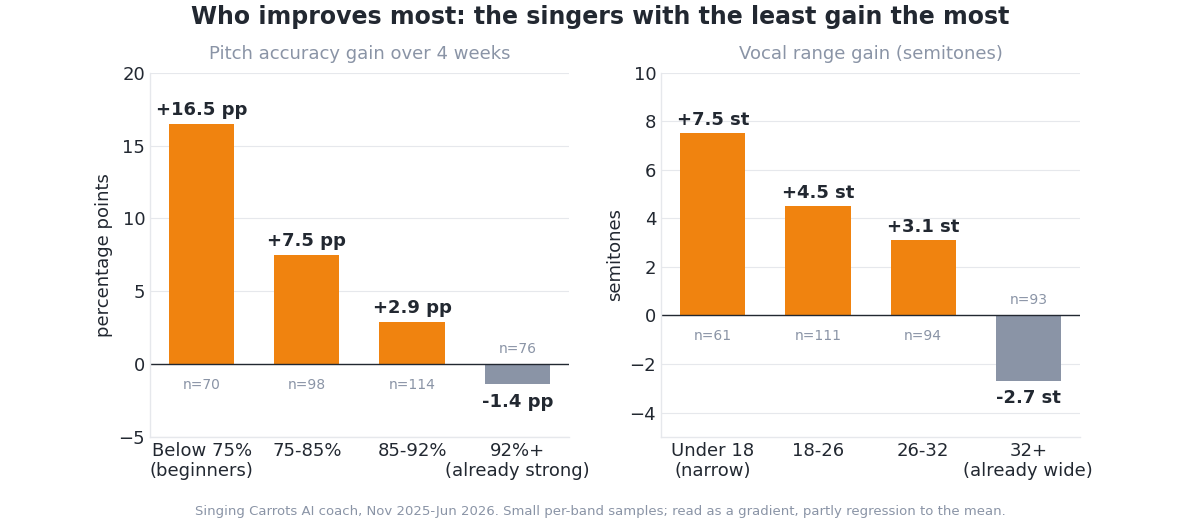
| Starting pitch accuracy | Singers | Start | After 4 weeks | Average gain |
|---|---|---|---|---|
| Below 75% (beginners) | 70 | 65.7% | 82.2% | +16.5 pp |
| 75-85% | 98 | 80.3% | 87.8% | +7.5 pp |
| 85-92% | 114 | 88.7% | 91.6% | +2.9 pp |
| 92% and up (already strong) | 76 | 95.1% | 93.8% | -1.4 pp |
Some of this is regression to the mean: a singer who scored very low in their first week may have had a rough day and simply scores closer to their true level later, and the same in reverse for the top band. We flag that openly because it is the obvious objection. But regression alone does not explain a gradient this steep and this consistent across two independent measurements, because the same pattern appears in vocal range:
| Starting range | Singers | Start | Latest | Average gain |
|---|---|---|---|---|
| Under 18 semitones (narrow) | 61 | 14.5 | 22.0 | +7.5 semitones |
| 18-26 semitones | 111 | 22.0 | 26.5 | +4.5 semitones |
| 26-32 semitones | 94 | 28.4 | 31.5 | +3.1 semitones |
| 32+ semitones (already wide) | 93 | 38.8 | 36.0 | -2.7 semitones |
Two independent metrics, the same shape: the singers with the most room to gain gain the most. That tracks with what beginners tell us:
“As someone who has always been told they can’t sing, I am finding these sessions very helpful and I am making progress.”
Put simply, the strongest case in this data is for an AI singing coach for beginners: the singers with the least skill and the least confidence improved the most.
The improvements held at three months
The biggest caveat in our first post was time. Four months is early, and a first-month jump could be a honeymoon effect that fades. So this time we looked at the singers we could follow for three months or more, comparing their first week to their practice 90 or more days later.
- 94 singers had enough data in both their first week and three or more months in. This is a retention-defined subset (people who kept practicing), so it speaks to singers who stuck with it, not to everyone.
- Their average accuracy went from 83.5% to 89.6%, a +6.1 percentage point gain still held at three months.
- 78% were still better than in their first week.
Within that group, the early gains were not a spike that washed out. Three months later they were still there.
Deeper conversations track better outcomes
An AI singing coach is not just a pitch meter with a chat window. A pitch detector tells you whether the note you sang was sharp or flat. A coach also decides what you should sing next, notices when you are straining, eases off, and adjusts the plan, all through the conversation. So we checked whether the conversation tracks anything, or whether it is decoration.
It tracks engagement closely. When we group singers by how much back-and-forth they typically have in a session, conversation depth lines up almost perfectly with how often they return:
| Typical exchanges per session | Singers | Average sessions completed |
|---|---|---|
| Under 10 | 67 | 1.2 |
| 10-20 | 504 | 4.1 |
| 20-35 | 893 | 7.4 |
| 35+ | 317 | 9.3 |
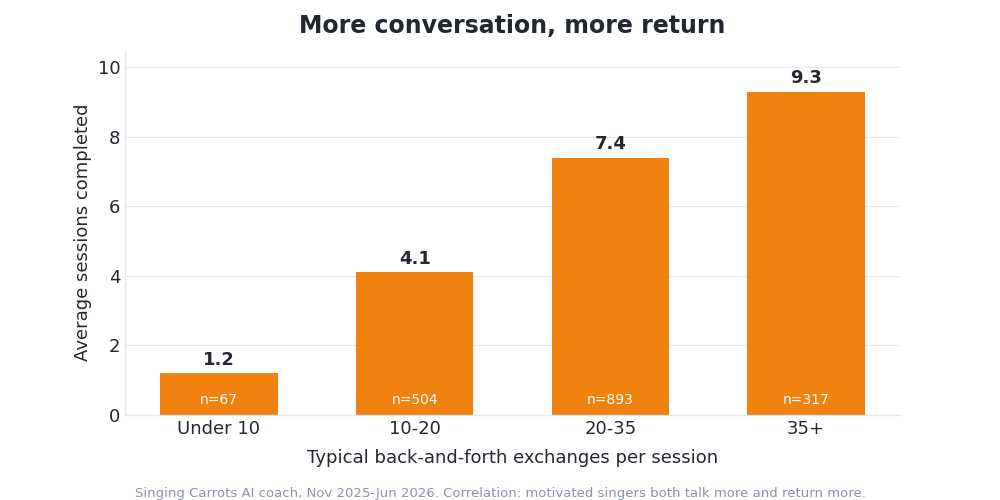
It also tracks improvement, not just retention. Among singers measured at week zero and week four, those who had deeper conversations (20 or more exchanges per session) improved by +6.2 percentage points, versus +4.5 for those who kept it short.
We cannot say the conversation causes the better outcomes. Motivated singers both talk more and improve more, so a good part of this is who shows up, not what the coach does. It is a correlation. But it is a consistent one across both returning and improving, and it is the part of the product that a plain pitch detector does not have.
One detail in passing: the average session has grown from around 20 exchanges at launch to about 30, and held there. Nearly seven in ten sessions now run to 20 or more exchanges.
“Great feedback from the AI. It adjusted on the fly to make the intervals more comfortable for me in my first session.”
What still gets in the way
We read the low ratings carefully, because they tell us where the tool fails real people. The complaints cluster around a few themes:
- Microphone and latency friction. The most common source of frustration is setup, not coaching. When the mic mishears a note or the visual feedback lags, the session feels wrong. One singer spent it “adjusting my latency ms values” instead of singing.
- Pacing and difficulty. Some singers feel the coach pushes too high, too fast. “The higher notes were above my comfortable range.” Getting the working range right for each singer is ongoing work.
- Beginner overwhelm. The flip side of helping beginners most: some arrive with no vocabulary at all. “I don’t know what any of that means. Complete beginner.” That is on us to explain more, not assume.
And one honest note on the trend: average session ratings drifted down over the spring (from about 4.7 to about 4.4) as the audience broadened. Still high, but the direction is a reminder that a wider, more casual user base is harder to satisfy than early adopters were.
What this means for learning to sing
A good vocal coach costs $60 to $150 an hour. Most people who would love to sing better never book that lesson. They are not deciding between an AI coach and a human one; they are deciding between an AI coach and nothing.
What seven months of data suggests is that this is the group that gains the most. The singers who improved the most were not the ones who were already good. They were the beginners, the people with the narrowest range and the least confidence. Within the group that kept practicing, the gains held for months. And the more someone engaged with the coaching, the better they tended to do.
We are not claiming the AI replaces a great teacher. The narrower claim the data supports is that for a beginner with no teacher at all, a coach that shows up at 7pm on a Tuesday, stays in a comfortable range, and gives enough structure to come back tomorrow is measurably better than practicing alone, or not practicing at all.
“Love this app. I’m learning so much and gaining confidence.”
A note on limitations
The caveats above are not boilerplate; they bound every result in this post. Collected in one place:
- No control group. We can show coached singers improved. We cannot compare them against an identical group doing the same amount of self-guided practice. Some of the gain is the coaching and some is simply practicing more.
- Self-selection. Singers who talk more with the coach, or who keep coming back, are probably more motivated to begin with. The conversation-depth and durability patterns are correlations on self-selected subsets, not proof of cause.
- Regression to the mean. Part of the large beginner gain is statistical, since extreme first-week scores tend to move toward the middle on their own. We think the effect is real because the gradient is steep and consistent across two metrics, but the true beginner gain is likely somewhat smaller than +16.5 points.
- Small subsets. The headline scale (2,000+ singers) is not the same as the sample behind each finding. The beginner band is 70 singers and the three-month cohort is 94. Treat them as directional.
- Vocal range is noisy. Range depends on warm-up, fatigue, microphone, and time of day. We report averages across hundreds of singers so the noise washes out directionally, but individual numbers are rough.
- Three months is still early. Long enough to rule out a one-week honeymoon, not long enough to call it permanent.
With those stated, the direction is consistent across every cut of the data we ran.
Frequently asked questions
Does an AI singing coach work for beginners?
In our data, beginners benefited the most. Singers who started below 75% pitch accuracy improved by about 16.5 percentage points over four weeks (70 singers), far more than singers who were already accurate, and singers with the narrowest vocal range expanded it the most. Sample sizes per group are small, so treat the figures as directional, but the pattern is consistent across two independent metrics.
Do the improvements from AI vocal coaching last?
Among the singers we could track for three months or more (94 of them), the average pitch accuracy gain was still +6.1 percentage points and 78% were still better than in their first week. That group self-selected by continuing to practice, so it speaks to singers who stuck with it rather than to everyone who tried it once.
What is the difference between an AI vocal coach and a pitch detector?
A pitch detector tells you whether a note was sharp or flat. An AI vocal coach also decides what you should sing next, builds a plan from your range and goals, notices when you are straining, and adjusts in real time through conversation. In our data, the depth of that conversation correlated with how much singers practiced, how often they returned, and how much they improved, though motivated singers both engage more and improve more, so this is a correlation rather than proof.
How long does it take to improve with an AI singing coach?
Most of the improvement happens early. In a paired analysis of 358 singers, pitch accuracy improved by an average of 5.9 percentage points over four weeks, with the largest jump in the first week and beginners improving far more than already-accurate singers. Gains then continue more gradually with sustained practice.
Read more
To get an overview of the AI Vocal Coach app field, and how they stack up in terms of being more than just pitch monitor or range apps, read our comparison article: Top 7 AI Vocal Coaches, based on real data. Also read: Can AI replace a vocal coach? An honest answer.
Also read: How to practice with an AI vocal coach: the session ritual
Data covers November 26, 2025 through June 18, 2026, from Singing Carrots’ production database. Feedback quotes are anonymized in-product session feedback, reproduced with minor spelling corrections only.
Singing Carrots is an online vocal training platform used by over 300,000 singers. Try the AI singing coach.