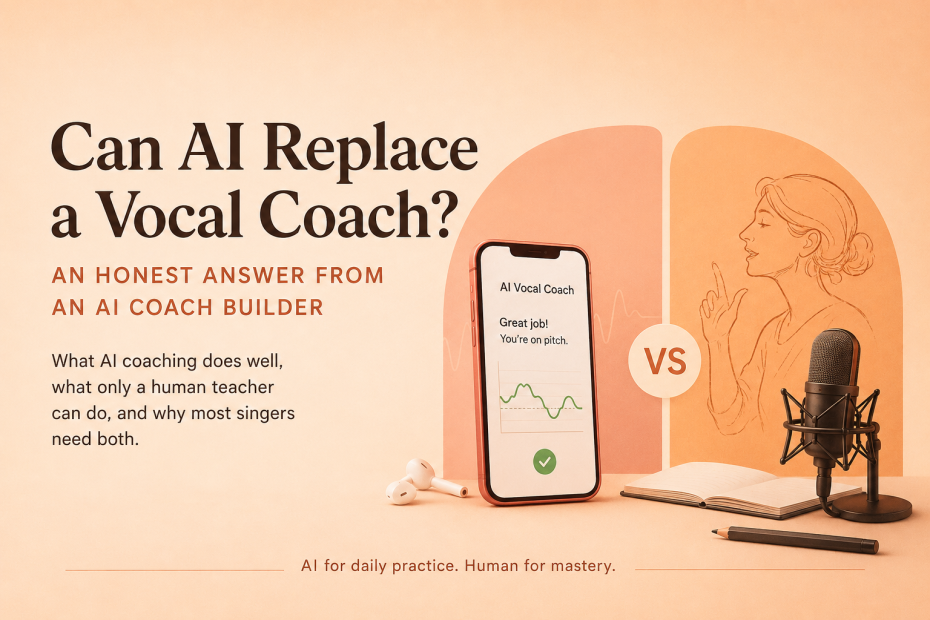
No. An AI vocal coach cannot replace a good human teacher (and we build one). A human hears nuance no algorithm measures, watches your posture and jaw, and protects your vocal health. What AI coaching does is different: daily deliberate practice with instant feedback, at 7pm on a Tuesday, for a fraction of a lesson’s cost. For most singers, the real choice isn’t AI versus teacher — it’s AI versus nothing. The fastest progress comes from combining both.
This is an unusual article for a company to write. We make the Singing Carrots AI vocal coach, and the question in the title is the one we’re asked most by two very different groups: singers deciding where to spend their money, and vocal teachers deciding whether tools like ours are a threat. Both deserve the same honest answer, so here it is — with the data we’ve published, the limits we’ve hit, and what we actually think the next years look like.
What only a human teacher can do
Start with the ceiling, because it’s real. A good human teacher:
• Hears what algorithms don’t measure. Tone color, tension you can’t feel yet, the difference between a note that’s technically on pitch and one that’s alive. Our coach measures pitch to the cent; it does not hear beauty.
• Sees your body. Posture, jaw, shoulders, breath… half of vocal technique is physical, and a teacher watches you produce the sound, not just the sound itself. An app hears a symptom; a teacher sees the cause.
• Protects your instrument. Strain, fatigue, and early signs of vocal damage need an experienced human ear and, sometimes, a referral. No responsible app should be your vocal-health advisor.
• Teaches artistry. Interpretation, style, performance, the courage to be heard. These are taught through human relationship, demonstration, and encouragement. They are not exercises.
• Holds you accountable to a person. For many singers, the fact that a teacher is expecting them is the practice plan.
If you have access to a teacher like this and can afford regular lessons, nothing in our data suggests an app should replace them.
What AI coaching does well, and the data behind it
The AI coach’s advantages are narrower, but they’re real and measured:
• It’s there when the teacher isn’t. Daily practice is where skills are actually built, and most of it happens between lessons — or without lessons at all. The coach shows up at any hour, never runs out of patience, and never judges a bad day.
• Instant feedback on every note. You can’t accurately hear your own voice while singing — real-time visual pitch feedback closes that loop, and it’s one of the best-evidenced interventions in singing pedagogy. In our published seven-month data, singers using the coach improved pitch accuracy by +5.9 percentage points in four weeks; beginners gained +16.5.
• It genuinely adapts. The coach keeps 91.5% of exercises inside your demonstrated comfortable range and reacts to every attempt — the mechanism analysis has the full picture. This matters because, as the independent Singing Start Guide review rightly notes, the extreme notes a range test records are often ones you can hit but not actually use musically. That’s exactly why the coach trains inside your comfortable zone rather than at the edges of your measured range.
• It costs a fraction of a lesson. A good vocal coach runs $60–150 an hour. That price is fair for what a teacher provides — and out of reach for most people who’d love to sing better.
The comparison most people are actually facing
Here’s the reframe that seven months of data forced on us: the typical singer using an AI coach was never deciding between the app and a teacher. They were deciding between the app and nothing.
The singers who improved most in our data were not the trained ones refining their craft. They were beginners — the people with the least skill, the narrowest range, and the least confidence, many of whom had been told somewhere along the way that they “can’t sing.” Most of them were never going to book a $100 lesson to test that verdict. For that person, the honest comparison is structured daily practice with real-time feedback versus unstructured singing along in the car — or versus silence.
That is the gap AI coaching fills. Not the teacher’s chair — the empty room where no teacher was ever going to be.
What each is best at
| Human vocal teacher | AI vocal coach | |
|---|---|---|
| Best at | Technique, artistry, vocal health, accountability, hearing what machines can’t | Daily deliberate practice, instant pitch feedback, patience, availability, price |
| Cadence | Weekly or occasional lessons | Daily 10–20 minute sessions |
| Feedback | Expert, holistic, sees your body | Instant, objective, every note |
| Strongest for | Intermediate to advanced singers; anyone with strain or health concerns | Beginners building pitch and range; practice between lessons |
| The honest limit | Cost and scheduling: $60–150/hour, and the other six days of the week | Doesn’t hear artistry, see posture, or safeguard vocal health |
Notice what the table implies: the two columns barely compete. They cover different days of the week, different stages, and different halves of the skill. Which is why the singers who progress fastest in every study of practice we’ve read — and in our own data on engagement — are the ones who combine structured daily feedback with periodic expert instruction. Occasional lessons to set technique; daily coached practice to build it in.
If you’re a vocal teacher reading this
You may have arrived here checking whether we’re coming for your students. The straight answer: your students who use an AI coach practice more between your lessons — and practice is the part of your job you’ve never been able to supervise. The coach drills pitch and range in a singer’s comfortable zone; it sends them back to you for everything that actually requires you. Several teachers already recommend structured app practice between lessons for exactly this reason, the way instrumental teachers assign metronome work.
We’d rather build for that partnership than pretend it isn’t the right model. If you teach and want to see what your students would see, try our AI coach. We publish our data, including the unflattering parts, so you can judge our claims the way you’d judge a student’s intonation: by ear, against the evidence.
So what should you actually do?
• Complete beginner, no teacher, tight budget: start with the AI coach. The data says you’re the person it helps most. Add a human teacher when you can — even occasional lessons compound.
• Already taking lessons: keep your teacher; use the coach for the six days between lessons. Tell your teacher what you’re practicing — the combination is the point.
• Intermediate or advanced, working on style and performance: a human teacher is your main investment. The coach is a practice-room tool for keeping accuracy and range sharp.
• Any strain, pain, or vocal health worry: a human professional, full stop. No app has any business in that conversation.
And if you’re still weighing whether AI coaching delivers anything at all, the evidence — ours and independent research — is here. Or skip the reading and try a session — the coach will meet your voice where it is. Also check out our post Is Singing Carrots worth it?
FAQ
For a beginner’s first goals — singing on pitch, expanding range, building a practice habit — an AI coach covers a lot, and the data shows beginners gain the most from it. But “replace” is still the wrong word: a teacher catches physical habits early, before they harden. The budget-realistic path many beginners take is app-first, teacher-when-possible.
That’s arguably when it’s most useful. Lessons set your technique; the six days between them are where it’s built or lost. An AI coach structures those days with instant feedback in your comfortable range — the singing equivalent of a metronome and a practice journal that talk back.
Capabilities will grow, but the core of teaching — hearing artistry, seeing the body, safeguarding vocal health, and the human relationship that keeps a singer going — isn’t a feature gap; it’s a different kind of work. We expect the tools to keep taking over the drilling, and teachers to keep owning the teaching. That’s the model we’re building for.