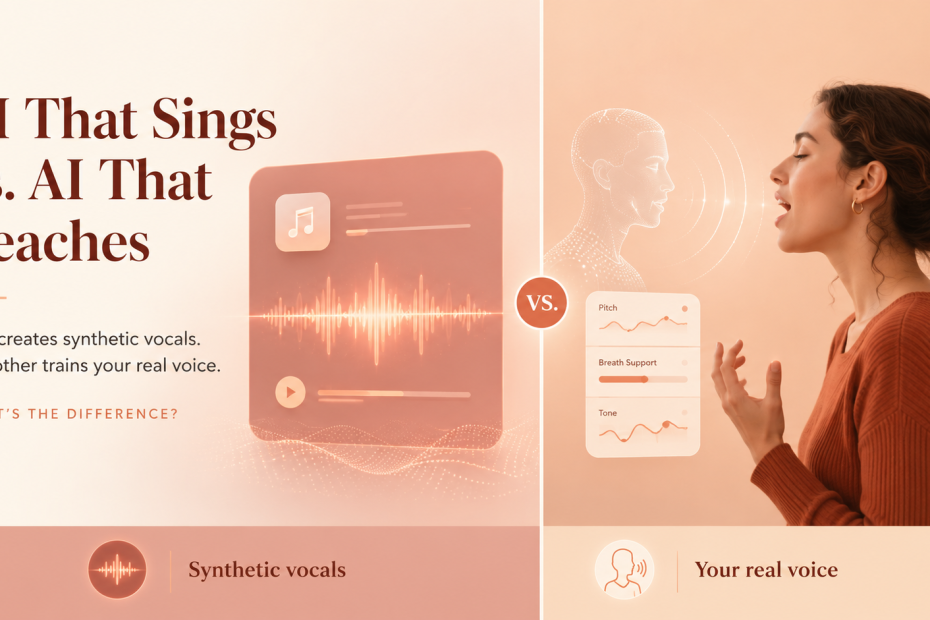
“AI singing” means two opposite things. AI voice generators (Suno, Udio, voice cloning) create synthetic vocals — the AI sings so you don’t have to. AI vocal coaches do the reverse: they listen to your real voice and train it. One replaces your voice; the other develops it. Which one you want depends on whether you need a finished vocal track, or a better voice.
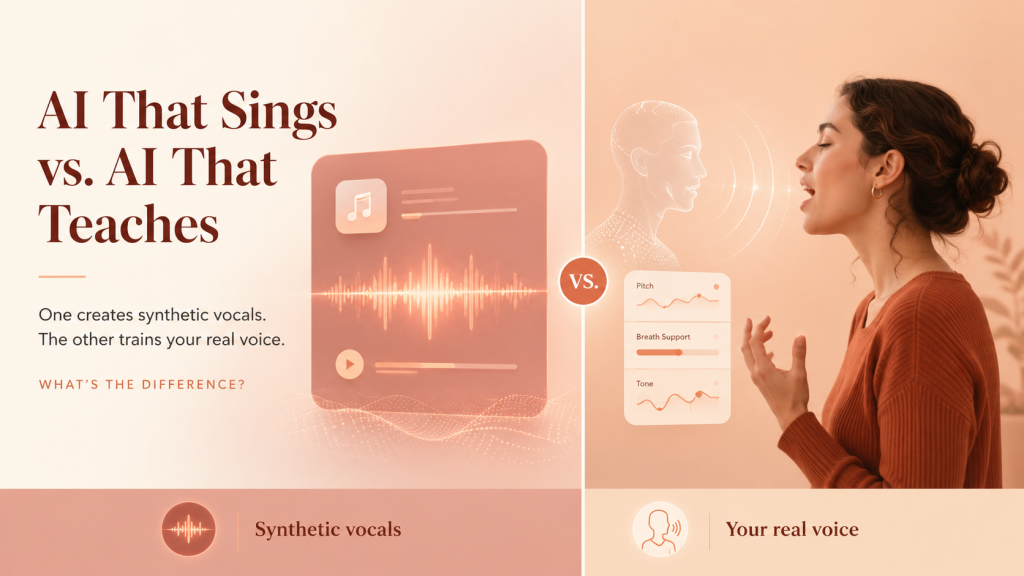
Type “AI singing app” into a search engine or an AI assistant and you’ll get a mix of two product categories that share three words and nothing else. This page exists to un-mix them — because choosing the wrong one wastes your money, and because the difference says something interesting about what people actually want from their voices.
Why does “AI singing” mean two different things?
The confusion is recent. For years, “AI singing app” could only mean training tools — apps that listened to your pitch and helped you improve. Then generative AI arrived, and suddenly the same phrase also described tools that produce complete synthetic vocals from a text prompt: full songs, cloned voices, AI covers of famous singers.
Both categories are real, both are growing, and both legitimately involve “AI” and “singing.” But they point in opposite directions: one produces a voice that isn’t yours; the other improves the one that is.
What does AI that sings for you do?
AI voice generators create vocal audio. Give them a text prompt, a melody, or a reference voice, and they output a sung performance — no human singing required. The category includes:
• Song generators (Suno, Udio and similar): produce complete songs with synthetic vocals from a text description.
• Voice cloning and conversion: render a melody in a modeled voice — including, controversially, the voices of famous singers.
• Text-to-sing tools: turn typed lyrics into sung lines for demos, jingles, or video soundtracks.
These are legitimate creative tools. If you need a vocal track for a video, a demo of a song you wrote, or you simply want to hear an idea performed without booking a singer, a generator is exactly the right tool. What it will never do is change what happens when you open your own mouth.
What does AI that teaches you to sing do?
An AI vocal coach points the microphone the other way. It listens to your real voice in real time, measures your pitch, and coaches you — choosing exercises for your range, reacting when you struggle, and tracking your progress across sessions. (The full definition, and how coaches differ from simple pitch detectors and karaoke apps, is in What Is an AI Vocal Coach?)
The output isn’t an audio file. It’s a measurable change in you: in published seven-month data, beginners using an AI coach gained +16.5 percentage points in pitch accuracy over four weeks. A generator gives you a track today; a coach gives you a voice that’s better next month.
The difference at a glance
| AI voice generators | AI vocal coaches | |
|---|---|---|
| What it does | Creates synthetic vocals from text or a reference | Trains your real voice with live feedback |
| Your voice’s role | Optional — the AI sings | Central — you sing, the AI listens |
| Output | An audio file | An improved you |
| Relationship to singers | Replaces the performance | Empowers the performer |
| Examples | Suno, Udio, voice cloning tools | Singing Carrots, pitch trainers, vocal coach apps |
| Right tool when… | You need a vocal track | You want to sound better yourself |
Which one do you actually want?
• “I need a song with vocals for my video / game / demo” — voice generator. That’s its job, and no coaching app will do it.
• “I want to stop being embarrassed at karaoke” — AI vocal coach. A generated track won’t be on stage with you.
• “I wrote a song and want to hear how it sounds sung” — generator for the demo; coach if you intend to be the one performing it.
• “I want my recordings to sound better” — depends what “better” means. AI pitch correction polishes a recorded take (that’s production, adjacent to generators). A coach makes the next take genuinely better, no polish needed.
• “I’ve always been told I can’t sing” — coach, and the data is on your side: the least accurate singers improve the most.
Where the two worlds meet
Here’s the detail that convinced us these categories aren’t really competitors: in the questions singers ask our AI coach, a recurring request is to roleplay a famous singer — teach me the way Freddie Mercury would. Nobody asks the coach to sing Freddie for them; generators exist for that. They want to become the voice they admire, one exercise at a time.
That’s the honest division of labor. Generative AI is changing what recorded music can be made without a singer. It has changed nothing about why people want to sing — and no generated track scratches that itch. The two categories will keep growing side by side because they serve two different human wants: hearing a song, and being the one singing it.
If yours is the second one, the AI vocal coach is free to try — bring the voice you have, and see what it does with it.
Yes: AI voice generators like Suno and Udio create complete synthetic vocals from a text prompt, and voice-conversion tools can render a melody in a modeled voice. These are creation tools for producing vocal tracks; they don’t involve or improve your own singing.
A voice generator creates synthetic vocals — the AI does the singing and the output is an audio file. An AI vocal coach listens to your real voice, gives real-time pitch feedback, and trains you — the output is measurable improvement in your own singing. One replaces your voice; the other develops it.
Two opposite kinds. AI pitch correction and voice enhancement process a recording after the fact — your track sounds better, your voice is unchanged. An AI vocal coach trains you with live feedback, so your voice itself improves: in published data, beginners gained +16.5 percentage points in pitch accuracy over four weeks. Quick fix versus real change.
Some do, for a different purpose: not to generate a singing voice, but to power the coaching conversation — interpreting your results, planning your session, and explaining what to work on, the way a teacher talks. The AI generates guidance; the singing stays entirely yours.