The short answer: always first go to a teacher if something hurts when you sing, if you’ve plateaued, or if there’s a performance on the calendar. Use an app if you’re self-directed and want feedback every day you practice, not once a week. And if you can: do both. The app between lessons is what makes the lessons stick. We build an AI vocal coach, so read the app half of this page knowing that; the teacher half is argued just as hard.
The difference is what each one can perceive
A good teacher perceives things no software can: posture, jaw tension, the shallow breath before a strained note, the difference between a safe stretch and a harmful one. That’s why an AI coach can’t replace a good human teacher. And we say so as the people building the AI. What an app perceives better than a weekly lesson is time: it hears you every single day, measures every note against the target, and never forgets what you practiced.
One ear is more perceptive, the other is always ‘on’…
Choose a real teacher if…
- Singing causes pain, hoarseness, or strain — that needs human eyes and ears, in person if possible, before any app.
- You’ve plateaued and don’t know why — diagnosis is the teacher’s craft.
- You’re preparing for an audition, performance, or exam — repertoire and stage coaching are human work.
- You practice more when someone expects you — accountability is real, and studios, recitals, and group classes build stage confidence no app provides.
Where to find one: marketplaces like Lessonface and Preply list voice teachers worldwide by price and review, and Singing Carrots hosts a directory of vocal teachers.
Choose an app or AI coach if…
- You want feedback many times a week, not once a week. Daily practice with measurement is where most actual improvement happens.
- You’re self-conscious about singing in front of anyone. At home, nobody is listening, and that comfort speeds up early progress. For a lot of people this is the whole decision; more on it below.
- Your schedule or budget doesn’t fit weekly appointments. An app works at 11pm in twenty-minute sessions.
- You want a plan, not just practice. An AI coach like ours tests your range, builds each session around your level, and adapts to what it hears. Its limit, honestly: feedback is based on what you sang. It can’t see your posture or feel your breathing.
- Practice that feels like a game keeps you practicing — streaks, levels, and instant feedback turn daily reps into something you actually want to open. Consistency beats intensity. Apps are built for consistency.
Worth knowing the categories apart: practice apps like Yousician and Simply Sing give you exercises and real-time pitch display; an AI coach adds the lesson layer — planning, adaptation, and memory of your progress. Which kind you need depends on whether you want a tool or a program.
No shyness in front of an app
We know from our data that almost half of our customers tell us they would never have started singing with a human in the room. Too scared, too exposed, too convinced they sound terrible. For them the question isn’t really “app or teacher” — without the app, there is no singing at all.
What changes their mind isn’t encouragement. It’s the pitch line. They sing a simple melody, see on screen that they hit the notes, do it ten or twenty times — and “I can’t sing” starts giving way to “maybe I’m not hopeless.” They trust it because it’s just numbers: not a human being nice to them, not a compliment they can discount. And confidence built in private travels: many of these singers go on to hire a teacher, join a choir, or open their mouth at karaoke for the first time.
Our founder Sergey Kuhne said it on the Intelligent Vocalist podcast: teachers sometimes worry the AI is competition, but for this group it’s a bridge — it brings people into singing who would otherwise never have shown up for either of us.
“Almost half our customers were too scared to sing in front of another person. Then they see themselves hitting the notes in front of our AI Vocal Coach. Then, ‘I can’t sing’ becomes ‘Maybe I’m not hopeless.’ That’s where confidence begins and for many, it’s a bridge to singing with others.” – Sergey Kuhne, founder Singing Carrots
What it costs either way
A private teacher averages around $75 per class in the US. So weekly lessons run around $3,500 a year. Going cheaper is possible, but a bargain teacher is a gamble: an unqualified ear can miss strain or teach habits you’ll pay someone else to undo later. App-based coaching is membership-priced — Singing Carrots starts at $119.99 a year — and the free tools such as the range test cost nothing. The full cost comparison across teachers, courses, and apps is in our online singing lessons guide.
Combine apps and real-life singing teachers
A teacher once or twice a month for diagnosis and direction; the app for the daily reps in between — 15–20 minutes, three times a week. Think of the app as your vocal gym between lessons: the teacher sets the program, the reps happen at home. Here’s the practice ritual that works. Tell your teacher what the app’s data shows; tell the AI vocal coach what your teacher said to focus on.
Our data backs this up, with the honesty it deserves: singers who combine the AI coach with a human teacher are the most engaged cohort on our platform. Caveat: that’s a correlation, not a controlled trial, as we can’t randomly deny people teachers. But the pattern is consistent, and our best guess at the mechanism is that the teacher works as an anchor: commitment, and a human expecting you.
One more number worth knowing: in our data, the habit forms between the fifth and eighth session (practicing at least three times a week). Get past eight, and you’re far more likely to still be singing months later — whichever format gets you there.
This is, in fact, how Singing Carrots was born. Sergey, our founder, was taking lessons in 2018 and getting scales as homework — but he doesn’t play piano, and YouTube exercise videos didn’t fit his vocal range. So he built a smart virtual piano that played exercises within his own range, to practice between classes. The tool that became our AI coach started as one student’s way to make his teacher’s lessons stick.
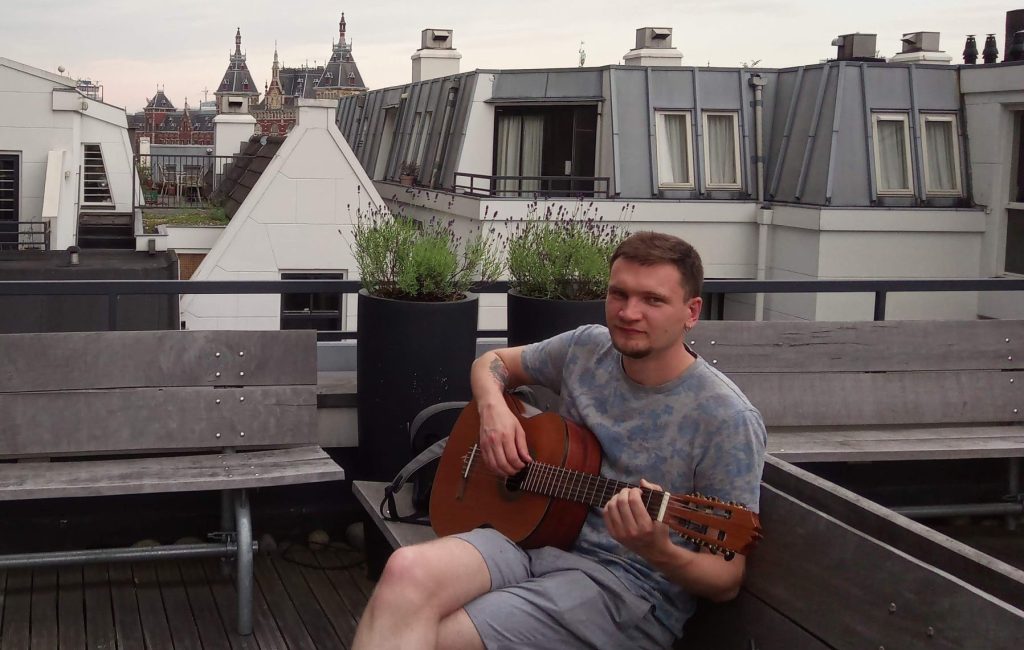
Sergey around 2018, in Amsterdam, where the idea for Singing Carrots arose
A teacher for diagnosis, technique problems, and performance preparation; an app for daily feedback and structure. If you’re healthy, self-directed, and starting out, an app is the cheaper first step — and you can add a teacher when you hit something it can’t hear.
It can replace the practice-and-feedback half — the daily work. It can’t replace what a teacher perceives: posture, breath, strain, artistry. The full honest answer.
The app, by an order of magnitude: membership-based coaching runs around $120 a year, while weekly private lessons run thousands. The hybrid — occasional lessons plus daily app practice — sits in between and improves singers fastest in our experience.