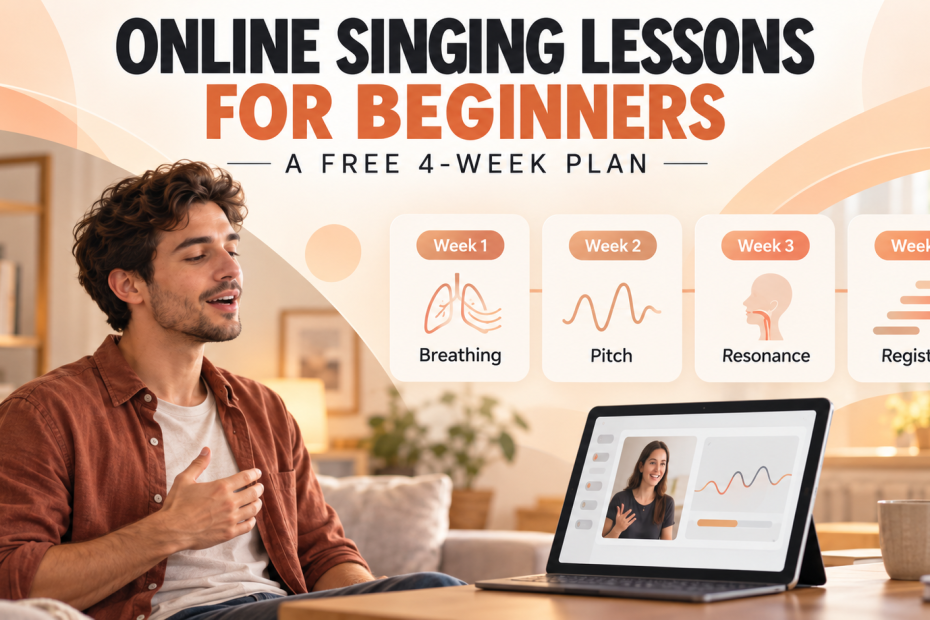
You don’t need a teacher, a studio, or a good voice to start. You need about 20 minutes a day, three days a week. Plus a quiet room, and a way to tell whether you’re actually hitting the notes. This is the exact 4-week plan we give absolute beginners inside Singing Carrots. The free parts, the paid parts, and how to measure progress. We also talk about the one situation where you should skip all of this and book a human vocal coach instead. We build an AI vocal coach, so we have a side. But the plan works whether or not you ever pay us ;)
What a beginner needs in month one
Three things:
- Breath you can control
- Pitch you can trust, and
- One song you can finish.
Everything else is built on those. Most beginners skip straight to singing full songs, get discouraged, and quit — the plan below is slower on purpose, because the foundation is what makes month two possible.
Before you start, record yourself. Sing one verse of something a cappella, or over a karaoke track, and save it. It will feel bad. Do it anyway — it’s your “before,” and in four weeks the side-by-side is the most convincing progress you’ll get. Then take the vocal range test and the pitch accuracy test. Both are free, no account needed, and they’re your baseline. You can’t tell if you’re improving without a number to improve from.

How to get over your fear of being heard
What’s standing between most beginners and week one isn’t pitch or breath but overcoming their fear of being heard. In a poll on Linor Oren’s YouTube channel, 62% of people said the fear of someone overhearing them was what kept them from practicing at home. That matches what we see in our own data: close to half the people who start with us say they’d never have sung in front of a live teacher at all. So if that knot in your stomach is what’s holding you back, you’re in good company.
Two low-tech tricks get you past your fear of your flat mate overhearing you singing. First, semi-occluded sounds: a lip buzz (“brr”), a hum, an NG, or a rolled R, held for about five seconds, then slid gently up and down your range like a small siren. They’re nearly silent through a wall and they wake your voice up without making you push. Second, the pillow: hold a cushion or folded blanket against your mouth and sing into it at full voice — it absorbs roughly 90% of the volume, so you can be loud and free without the whole house hearing. (Come up for air between phrases; don’t suffocate yourself for your art.)
Keep in mind: every time you practice, spend even thirty seconds singing with nothing in front of your face. It’ll feel exposed, but that’s the point. You have a right to make sound in your own home. Thirty seconds becomes a minute, a minute becomes a verse, and the fear shrinks a little each time you prove to yourself the neighbors survived.
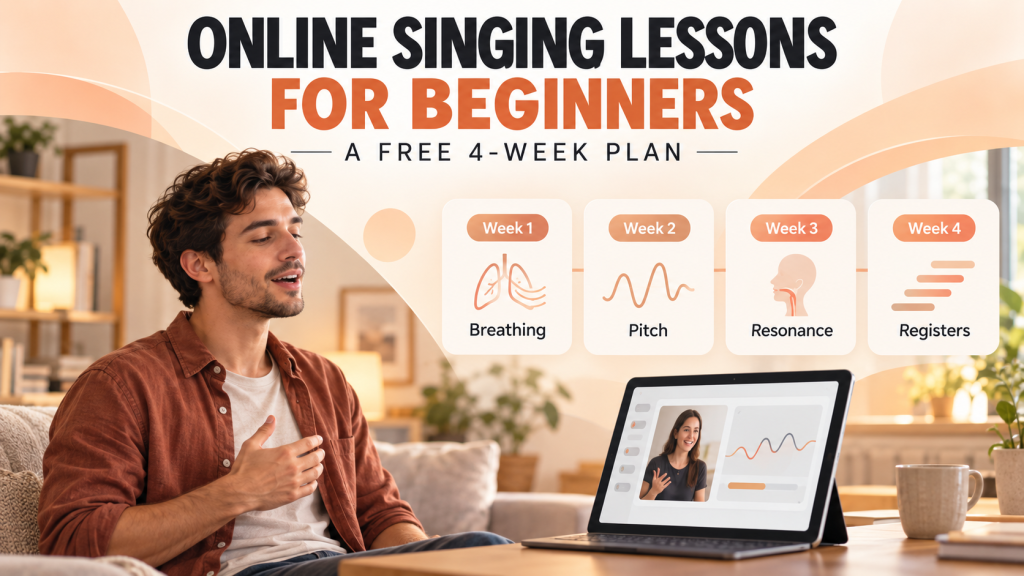
The 4-week plan, week by week
Three practice days a week, 15–20 minutes each. Each day: a short warm-up, the week’s focus exercise, and one song. The structure below is our From Zero to Singing Hero course, made public.
Week 1 — Breathing
Diaphragmatic breathing: inhaling low and wide instead of high and shallow, then controlling the exhale so the air lasts. This is unglamorous and it’s the single biggest lever a beginner has. Spend the week combining steady inhalation and controlled exhalation into the start of a sung note.
Week 2 — Pitch & intonation
Train your ear and voice to land on a target. Start with half steps and whole steps, then major thirds and perfect fifths, then octaves and full major scales. Use real-time pitch feedback so you can see the moment you’re sharp or flat and correct it — this is where the before/after number moves most.
Week 3 — Resonance
Where the sound sits: chest resonance, head resonance, and the mix between them. Find “mix” with a bit of twang. These exercises are about sensation and placement, not force — louder is not the goal, placed is.
Week 4 — Registers & the vocal break
Chest voice, head voice, mix, and smoothing the break between them — the crack most beginners are afraid of. It can be trained to sound smooth. Lip trills, “Ah–Ee–Ah” drills, and NG sirens carry you across the break without forcing. End the week by re-recording your “after” and re-taking both tests.
How to tell if it’s working
Two objective measures and one you can hear. The objective ones: re-take the range and pitch tests at the end of each week — not daily, because range especially is noisy from warm-up, fatigue, and time of day, so weekly readings separate real progress from a bad morning. The one you can hear: your week-4 “after” recording against your “before.”
About what to expect — honestly, because the data has caveats. In our own data, beginners improve the most: singers who started below 75% pitch accuracy gained around 16.5 percentage points over four weeks. That’s our strongest beginner finding, but the sample behind it is 70 singers, it’s observational with no control group, and some of the jump is regression to the mean, so treat it as directional, not a promise. The honest version: beginners who practice consistently for four weeks usually see a clear, measurable gain — and they gain more than people who were already good.
What’s free and what isn’t
You can run the whole measurement side for free. The vocal range test and pitch accuracy test need no account. The 4-week course and the pitch training game are included with a Singing Carrots membership, which starts at $119.99 a year. There’s no separate charge for the course. Uploading your own MIDI exercises needs a Pro plan. That’s the full picture: free to find out where you stand, paid to get the guided plan and daily feedback.
When a beginner should get a teacher instead
Skip the app and see a human, in person if you can, if singing causes pain, hoarseness, or strain — that is not something to practice through, and no app can see it. And if you’ve done four honest weeks and nothing has moved — not the tests, not the recording — a teacher can diagnose in one lesson what you can’t see from inside your own head. The app is the cheap, private first step; it isn’t the only step. If you’re weighing the two in general, we wrote that out: singing lessons app or a real teacher?
Yes, with one condition: you need feedback, not just videos. A beginner practicing alone can’t hear their own pitch reliably, so a plan that measures you — before/after recordings plus range and pitch tests — beats watching lessons you can’t check yourself against. In our data, beginners improved more than any other group.
You can start for free: the range and pitch tests cost nothing and give you a real baseline. A full guided plan with daily feedback is paid — Singing Carrots membership starts at $119.99 a year — but nothing stops you measuring where you stand today without paying.
Most of the measurable gain shows up early — within the first few weeks of consistent practice, with the biggest jump in week one. Four weeks of 20 minutes, three times a week, is enough to see a clear change in your pitch test and your recording. Range moves more slowly than pitch.