
Singing in tune is one of the biggest frustrations for beginners. You open your mouth, try your best, and somehow the note still comes out too high, too low, or just unstable. That can feel discouraging very quickly. A lot of people take that as proof that they “can’t sing,” but in most cases that’s not what is happening.
If a pitch accuracy test showed you drifting flat or sharp, these are the fixes. For what that score does and doesn’t mean about you, start here.
Singing in tune is a skill. It depends on a few trainable things working together: hearing the note clearly, managing the breath well enough to hold it, and producing the sound without extra tension. The good news is that those things can improve with practice. Research on singing ability shows that training and experience are linked with better pitch accuracy, which is exactly why beginners often sound more stable once they start practicing in a more focused way.
This article is here to make the problem feel simpler. We’ll look at the most common reasons people sing out of tune, what to do about them, and how to build a short daily routine that actually helps.
If you want the bigger roadmap behind these tips, start with the How to Sing guide.
What does “singing in tune” actually mean?
Singing in tune means matching the note you intend to sing and staying centered on it. If the note sits too low, you’re flat. If it sits too high, you’re sharp. Sometimes singers hit the note at first and then drift away from it a moment later. Other times they miss it completely because the ear and the voice are not quite lining up yet.
That’s important, because it means “out of tune” is not one single problem. It can come from hearing, breath, tension, range, or simple practice habits. Once you know which part is getting in the way, fixing it becomes much easier.
Why beginners struggle to sing in tune
Most beginners do not sing out of tune because they are hopeless. They sing out of tune because too many things are happening at once. They are trying to remember the melody, find the lyrics, breathe, stay relaxed, and judge whether the pitch is right — all at the same time.
That overload creates very normal problems. The breath gets shaky. The throat tightens. The pitch becomes less stable. And once the singer hears themselves slipping, they often tense even more, which makes it worse.
So if you’ve been asking yourself why do I struggle to sing in tune or why can’t I sing in tune, try not to turn that into a personality judgment. Usually it means your system needs clearer practice, not that your voice is broken.
1. Your ear is still learning pitch
One of the biggest reasons beginners sing off key is simple: the ear is still learning what to listen for. A lot of people can tell when something sounds “wrong” in a general way, but they can’t yet hear exactly how it is wrong. They may not notice whether they are flat or sharp until someone else tells them.
That’s why pitch work needs to begin small. Full songs are usually too complicated at first. It is much easier to train your ear with one note, then two notes, then a very short pattern. When you repeat those small tasks often enough, your ear starts noticing the difference between “close” and “correct.” Over time, that becomes much more automatic.
This is one reason good singers often seem more accurate than beginners even before they sing a full song. They have spent more time hearing and correcting small pitch differences. In practical terms, a lot of how to improve singing voice comes down to improving listening, not only vocal effort.
2. Your breath is making the note unstable
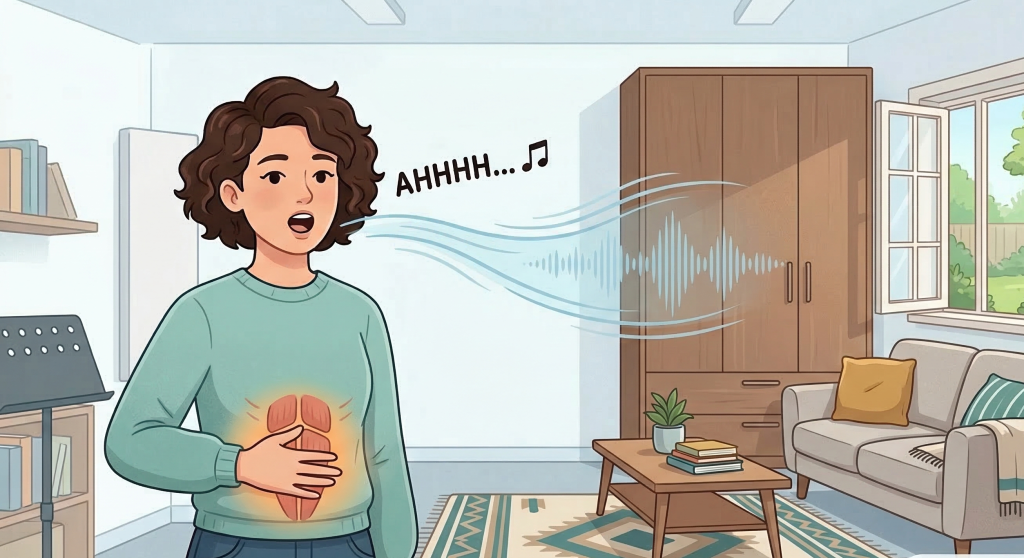
A note cannot stay steady if the airflow underneath it is unstable. Some beginners go flat because the breath fades too quickly. Others go sharp because they push too much air at the note. In both cases, the pitch becomes harder to control.
This is why breath support matters so much. The NIDCD explains that the voice is produced when air from the lungs moves through the vocal folds, and that good breathing technique helps support the voice without relying on throat tension. The same guidance also warns that whispering, pushing, and overusing the extremes of the range can all stress the voice.
The practical version of that is simple: do not try to overpower the note. Instead, aim for a clear, calm breath and a stable release of air. If you are trying to figure out how to improve vocals for singing, breath control is one of the first things to work on because it affects pitch, steadiness, and comfort all at once.
A good beginner drill is the hiss exercise. Breathe in quietly, then release the air on a soft “sss” for ten seconds. Keep it smooth. If the sound bursts, shakes, or dies early, that tells you your airflow is not steady yet. This small exercise is surprisingly helpful because it trains the breath before the note even begins.
3. You are too tense when you sing
A lot of singing problems are really tension problems.
The jaw tightens. The shoulders rise. The tongue pulls back. The throat starts doing work that the breath should be doing. Once that happens, the note becomes harder to place cleanly. So even if the singer knows roughly where the pitch should be, the body makes it harder to land there.
This is one reason people looking for how can I sing better often improve as soon as they stop trying so hard. Tension often comes from effort, fear, or self-consciousness. The singer is trying to “get it right,” but the body responds by locking up.
A better approach is to make the task smaller and the body calmer. Sing at a clear, natural volume instead of a whisper. Loosen the jaw before you start. Let the shoulders drop. Speak one sentence normally, then sing a comfortable note right after. That helps connect the voice to something more natural instead of something panicked.
If you want to know how to sing better, this is one of the most useful mindset shifts: singing in tune does not usually come from force. It comes from easier coordination.
4. You are practicing songs before practicing notes
This is one of the most common beginner mistakes. Songs feel fun and motivating, so people jump straight into them. But if pitch accuracy is still weak, a full melody is a very demanding task. It asks the ear, breath, timing, memory, and voice to cooperate all at once.
That is why it makes more sense to practice notes before practicing songs.
Start with one note. Match it. Hold it for two seconds. Stop. Repeat. Then move to a tiny pattern such as do–re–mi–re–do. Only when that feels more stable should you start applying the same control to a short melodic phrase.
This kind of practice may feel slow, but it works much faster than repeating an entire song badly. It is one of the clearest answers to how to get better at singing because it trains the part of the skill that actually needs work.
5. You are singing outside your comfortable range
Even a singer with decent pitch can go out of tune when the note sits too high or too low for them right now. That does not necessarily mean the range is impossible forever. It just means it is not stable yet.
Beginners often pick songs in the original key, try to copy the artist exactly, and then struggle when the melody moves outside their current comfort zone. As soon as they reach those edge notes, the pitch wobbles or the throat tightens.
A better approach is to work where the voice feels easier first. Get accurate in the middle of your range. Build control there. Then expand gradually.
This is one reason vocal range awareness matters. You do not have to know everything about voice types right away, but you do need to notice where your voice feels steady and where it starts to lose control. That awareness makes how to improve singing much more practical, because you stop setting yourself up for failure on notes your voice cannot yet manage comfortably.
6. You are not warming up
A cold voice is harder to coordinate. That alone can make pitch less reliable.
Warm-ups matter because they help the breath, vocal folds, and resonance settle into easier movement before you ask them to handle melody. Even a short warm-up can make singing feel smoother and more stable.
One of the best warm-up styles for beginners is SOVT work — semi-occluded vocal tract exercises such as lip trills, gentle humming, or straw phonation. These are widely used because they encourage easier voicing with less strain. They are also easy to repeat daily.
A simple version:
- do a light lip trill for 20 seconds,
- slide gently from low to mid-range. Pitch glides are like a gentle siren. Glides build pitch control and ease you toward the edges of your range without strain.
- repeat a few times,
- then sing one comfortable note afterward.
You do not need a long routine to notice a difference. You just need enough to stop throwing a “cold” voice directly into a song.
7. You don’t have enough feedback yet
A lot of singers repeat the same pitch mistakes because they do not hear them clearly enough in real time. That is where feedback becomes important.
Good singers are not magically perfect. They have simply spent more time hearing, correcting, and repeating. They use their ears, recordings, instruments, teachers, or visual pitch tools to notice where the note actually landed.
This is one area where Singing Carrots’ pitch tools fit naturally into the learning process. The platform’s pitch training is built around real-time visual feedback, pitch-matching tasks, and repeatable drills that help singers see when they are on or off pitch. You can use it as a tool for improving pitch accuracy, ear training, and vocal control.
That matters because feedback speeds up correction. Instead of guessing whether the note was close, you know.
So if you’ve wondered how do singers sing in tune, part of the answer is simple: they get more feedback, and they use it consistently.
A simple daily routine to sing in tune
You do not need a huge routine. You need a repeatable one. Try this 15–20 minute structure most days:
Start with 2 minutes of easy warm-up. Lip trills, humming, or a gentle “ng” sound are enough.
Then do 3 minutes of steady breathing. Use the hiss exercise and focus on keeping the airflow smooth.
Then spend 5 minutes matching single notes. Pick one note in a comfortable middle range and repeat it until it feels more stable.
Then do 5 minutes of short patterns. A simple do–re–mi–re–do is enough.
Finish with 3–5 minutes on one short melodic phrase from a song. Sing it slowly and stay inside your comfortable range.
That is enough to make progress if you repeat it often. It also fits naturally into the bigger how to sing process, because it focuses on the same basics: breath, pitch, ease, and consistency.
Conclusion
Learning how to sing in tune is not about being born lucky. It is about training a few basic things well enough that they start working together.
If you sing out of tune sometimes, that does not mean you are hopeless. It usually means the ear, breath, range, or coordination needs work. Those are exactly the kinds of things that improve with practice.
Keep the routine simple. Keep it regular. Do not judge yourself too early. Most singers sound steadier and more accurate once they stop trying to “force” the result and start building the skill step by step.
For the full roadmap behind all of this, go through the How to Sing guide.
Frequently Asked Questions
How do singers sing in tune?
They train their ear, breath control, and muscle memory. Good singers usually spend a lot of time noticing small pitch mistakes, correcting them, and repeating the right patterns until they become natural.
Why do I struggle to sing in tune?
Most beginners struggle because of weak pitch awareness, unstable breath, tension, or lack of feedback. In most cases, it is a trainable issue rather than a talent problem.
Why can’t I sing in tune?
Usually because one part of the system is not working well yet. Your ear may still be learning pitch, your breath may be unstable, or your body may be too tense. That does not mean you cannot improve.
How do I stop singing out of tune?
Slow down, warm up first, sing at a natural volume, match one note at a time, and practice small patterns before trying full songs.
Can anyone learn to sing in tune?
Most people can improve with regular practice. Research suggests that pitch accuracy is related to training and experience, which means many singers become more accurate over time.
How can I sing better if I always go off key?
Work on notes before songs, stay in a comfortable range, improve breath control, and give yourself feedback through recordings or pitch tools. Those basics usually make the biggest difference.
What is the rarest voice type?
Contralto is often described as the rarest standard female voice type.