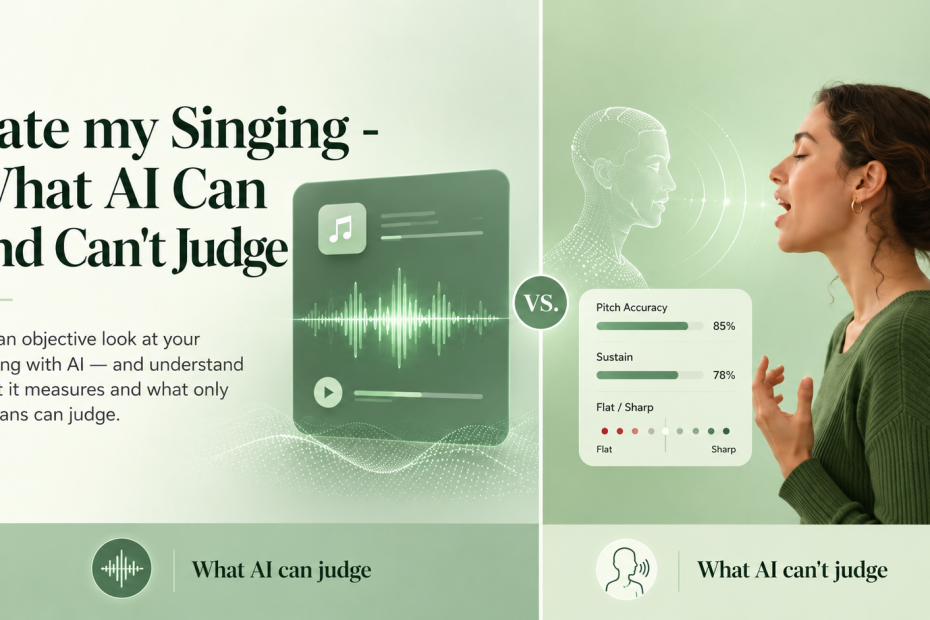
Want your singing rated? The honest starting point: a chatbot can’t hear you. What can actually rate your singing is a tool that listens. That would be our free pitch accuracy test. It rates your singing in two minutes. How precisely you hit each note, how steadily you hold it, and whether you miss flat or sharp. Free, in your browser, no sign-up. What no AI can judge is whether you move anyone. This page covers both halves.
What AI rates well
Software is genuinely good at the measurable layer of singing — better than human ears, in fact, at the cents level. When you take the test, you sing a short melody and a scale while it compares every note you produce against the target. You get:
- Precision: how close your notes land on the target pitch, with every note sorted from too low to too high. Slightly-off notes still count as hits; the pattern matters more than perfection.
- Sustain: how steadily you hold a note once you’ve found it. You don’t need 100%; 70–80% is already a strong result.
- Your flat/sharp pattern — and here AI has something no teacher’s ear can match: data. We analyzed 632,000 missed notes from singers using the test, and 65.7% of misses were flat — sung under the target. On rising melodies it’s 81.3%. If your result shows a run of “slightly low,” you’re in the majority, and drifting flat is one of the most trainable habits there is.
- Tone qualities: since mid-2026 the analysis also hears airiness, ring, vibrato, and loudness alongside pitch.
How to run the test and read every part of the result is covered step by step in the test guide. And if you’re wondering what a voice test even is and which kind you need, start here. How much to trust any online test: the honest caveats. Comparing every way to get rated – apps, AI tools, teachers, and your own ear – is covered in our guide to the best apps and tools to rate your singing.
One thing a rating can’t cover: your vocal range. Range isn’t scored. After all, there’s no good or bad range, only yours. Still, it’s worth measuring: our free range test maps your lowest and highest comfortable notes in about a minute and shows which famous singers share them.
What’s my voice out of 10?
A lot of people ask for a single number: “rate my voice from 1 to 10.” But know that any tool that scores your whole voice with one number is making it up. A voice isn’t one thing; it’s pitch control, stability, tone, range, and the extremely subtle aspects that (currently) no software hears. What a serious test gives you instead is a number per dimension: your precision score and your sustain score, in percentages. If you want the 1-to-10 feeling, the precision score out of 100 we give is the closest real thing.
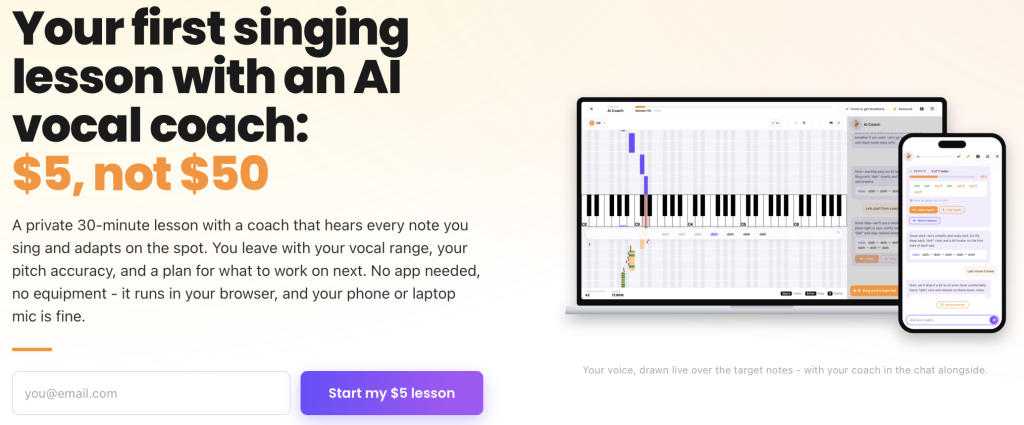
Try a lesson with the Singing Carrots AI Vocal Coach
What AI can’t judge
We build an AI vocal coach, so take it from us: the test measures singing; it doesn’t measure a singer. Vocal coach Linor Oren puts it best in our conversation about what makes a good singer: when people name a singer who gives them chills, “nobody ever says ‘the way they engage their pelvic floor.’ They say: they’re so real, they make me feel something.” She tells of an agent who interviewed opera jury members after auditions. It turns out that even they didn’t hire on flawless execution but on being moved by a singer.
There’s also a physical limit. The feedback is recording-based: software analyzes what came out of you, but it can’t feel what happened on the way. Think breath support, jaw tension, a raised larynx. Those are exactly the things a teacher catches in the first five minutes, which is why an AI coach can’t replace a human one, and we say so as the people building the AI.
Nobody ever gets chills from a singer because of the way they engage their pelvic floor. They say: they’re so real, they make me feel something.

What a low score means (and doesn’t)
If the test comes back worse than you hoped: know that true tone-deafness (congenital amusia) affects roughly 1.5–4% of people. Everyone else who “can’t sing” has a control problem, not a hearing problem. Research by Pfordresher and Brown, and by Hutchins, shows off-key singers usually hear pitch just fine. the breakdown is between ear and voice, and it’s trainable. Our rule for any score: take it as information, not identity. One reading on one day is just that: one reading.” The science and the stories of people who started as ‘bad singers’ are worth ten minutes of your time before you conclude anything about yourself. And when you’re ready to work on it: seven fixes for singing in tune.
A rating is a snapshot
The test tells you where you are. Don’t view it as a verdict, but as a datapoint that can become part of a trend. The AI vocal coach is what turns that into practice: it takes your results, builds sessions around your range and level, and adapts as you improve. Our data across 2,000+ singers shows beginners gaining 16.5 percentage points of pitch accuracy in four weeks. Fifteen to twenty minutes per session is enough; here’s the practice ritual that works. Then retest and watch the numbers move.
Frequently asked questions
Is there an AI that can rate my singing?
Yes. The free pitch accuracy test rates your singing in two minutes [/pitch-test] — precision, sustain, and your flat/sharp pattern, measured against the target notes. No sign-up.
Can ChatGPT rate my singing?
Not really. Chat assistants can’t hear you sing in a normal conversation. Upload-based feedback can comment on a recording, but it won’t measure your pitch in cents against target notes. For an actual score, use a tool with a microphone.
What app tells you if you can sing?
An app that measures pitch accuracy. Ours is free and browser-based. For how it compares to other singing apps, see the best apps to learn singing.
How do I know if I’m a good singer?
Test the measurable half (pitch, range) and ask the unmeasurable question: do people feel something when you sing?