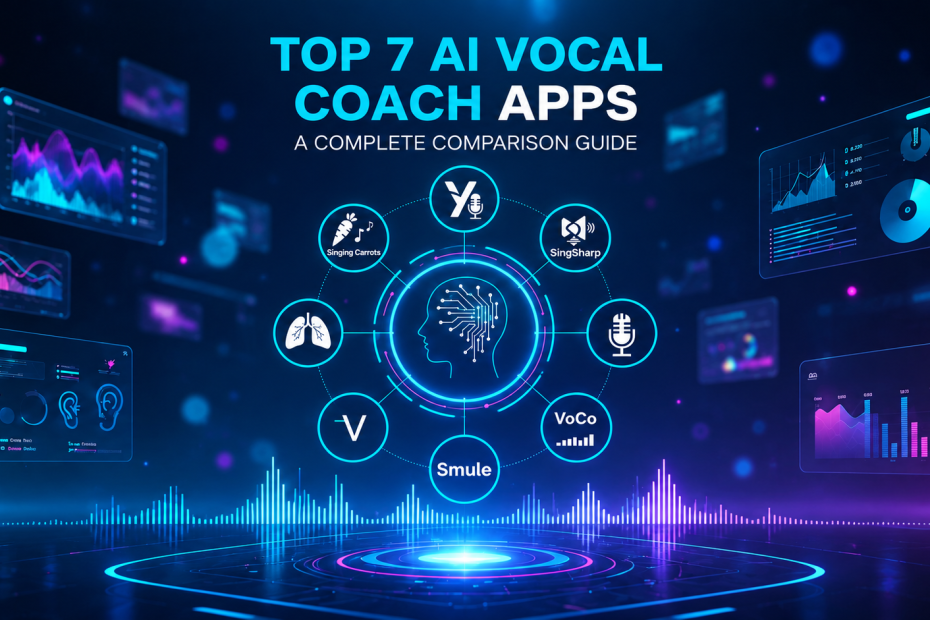
Singing Carrots is our pick for the best AI vocal coach in 2026. It’s the only app in this comparison with published outcome data (2,000+ singers, +16.5pp pitch accuracy for beginners) and a coach that plans, adapts, and remembers across sessions. Yousician is the best structured curriculum, Bloom Vocal the best for recorded song critiques, and Smule the pick for social karaoke.
Full disclosure: we build Singing Carrots — so below we tell you exactly who each app is better for than ours.
📱 Updated October 2026: Added a few apps. Plus: Singing Carrots AI Coach is now available as an iOS app — Singing Carrots AI Vocal Coach on the App Store — and as an Android app. In addition to the web version. The comparison below reflects this.
Transparency note: Singing Carrots publishes this guide. To keep the comparison useful, the table below includes rows where competitors beat us, and every claim about our own app links to published data you can check.
Which AI vocal coach is best? Quick comparison
| App | Best For | AI Capabilities | Price | Platform |
|---|---|---|---|---|
| Singing Carrots | Personalized coaching & progress tracking | AI session planning, cross-session memory | Free tier / Paid memberships | iOS, Android, Web |
| Yousician | Structured lessons & gamification | Real-time pitch detection | $7.49-$17.49/month | iOS, Android |
| SingSharp | Breath support training | Vocal analysis + breath detection | Free tier / premium | iOS, Android |
| Smule | Social singing & karaoke | Pitch correction effects | Free / VIP subscription | iOS, Android |
| Bloom Vocal | Recorded song critiques | Post-recording analysis & feedback reports | Credit packs from $5.99 (~25 min of analysis) | iOS, Android, Web |
| Simply Sing | Learning through songs | Range detection + real-time pitch tracking | Premium, ~$9.99–$89.99 (varies by plan/region) | iOS, Android |
| VoCo Vocal Coach | Professional exercises | Exercise customization | Free | iOS only |
1. Singing Carrots AI Coach — Best for True Personalized Coaching
What It Is: An AI vocal coach — on iPhone, Android, and in any web browser — combining real-time pitch detection with genuine AI coaching. It is the only app in this comparison that has published outcome data from its own users: 2,000+ singers, 13,000+ sessions, and roughly 349,000 exercises over seven months, with beginners improving most (+16.5pp pitch accuracy).
How the AI Works:
Unlike most apps that use “AI” as a buzzword for pitch detection, Singing Carrots employs a three-tier AI architecture:
- Reasoning Model: Analyzes your vocal profile and creates custom session plans
- Operational Model: Generates exercises in real-time based on your performance
- Context System: Remembers your history across sessions and adapts accordingly
The adaptation is measurable, not marketing: after a successful exercise the coach raises difficulty 31.5% of the time; after a struggle, only 3% — a 10x swing documented in What Actually Happens When You Sing to an AI Coach. And 91.5% of generated exercises land inside the singer’s demonstrated comfortable range.
Standout Features:
| Feature | What It Does |
|---|---|
| Personalized Session Planning | AI creates a custom lesson plan for each session based on your weaknesses |
| Cents-Level Tuning Analysis | Detects if you’re consistently sharp/flat and by how much |
| Pitch Stability Measurement | Identifies if your voice wobbles on certain notes |
| Per-Note Historical Tracking | Tracks your accuracy on every note across all sessions |
| Cross-Session Learning | Each session builds on previous ones—real progress tracking |
| 300-Note Daily Ceiling | Protects vocal health by limiting daily practice volume |
What Sets It Apart:
Most apps give you the same exercises regardless of your specific struggles. Singing Carrots’ AI might say: “You’ve been struggling with pitch stability above E4. Today we’ll focus on sustained note exercises in your comfortable range before working upward.”That’s coaching, not just feedback.
Honest limitations: The song catalog is for range-matching and practice, not licensed karaoke playback like Yousician’s or Smule’s. Full AI coaching requires a paid membership. See here for an extended, honest review if Singing Carrots is worth it.
Pricing: A free account previews some tests and tools; practice and study require a paid plan. Plans start from $119.99/year (≈$10/month). Prices as of Autumn 2026.
Best For: Singers who want teacher-like guidance and measurable progress tracking
Platform: iPhone and Android (app on the App Store, here’s the app on Android) or any web browser.
Try the Singing Carrots AI Singing Coach
2. Yousician Singing — Best for Structured Learning Path
What It Is: A gamified music education app that covers multiple instruments, including voice. Yousician offers a structured curriculum with level-based progression.
How the AI Works:
Yousician’s technology listens through your device microphone and provides instant feedback on pitch and timing accuracy. The app uses this data to track your progress through its curriculum.
Standout Features:
- Comprehensive curriculum covering breath support, pitch control, ear training, and music theory
- 10,000+ licensed songs (Premium+ only) organized by difficulty
- Auto-transpose feature adjusts song keys to match your vocal range
- Multi-instrument support if you also want to learn guitar, piano, etc.
What It Does Well:
According to American Songwriter’s review, Yousician provides “legitimate instruction and fun exercises that make learning to sing fun.” The structured path works well for beginners who want clear progression.
Limitations:
- Real-time pitch detection, not true AI coaching
- Same exercises for all users at each level
- Requires quiet environment for accurate feedback
- Limited song selection on basic plans
Pricing:
- Premium: $7.49/month (no real songs)
- Premium+: $11.66/month (includes song catalog)
- Premium+ Family: $17.49/month
Best For: Beginners who want gamified, structured lessons with clear progression
Platform: iOS, Android
For the full head-to-head, see Yousician vs Singing Carrots.
3. SingSharp — Best for Breath Support Training
What It Is: SingSharp is an AI-powered vocal coach that uniquely focuses on breath detection alongside pitch training—a critical but often overlooked aspect of singing.
How the AI Works:
SingSharp analyzes your vocal range, tone, and resonance to create personalized exercises. Its standout feature is breath detection technology that trains abdominal breathing—the foundation of healthy singing.
Standout Features:
- Voice Mentor AI provides personalized exercises and answers to singing questions
- Breath Detection Technology (first mobile app to implement this)
- Vocal character identification detects your unique range and resonance transitions
- Real-time feedback on pitch and vocal resonance
What It Does Well:
While most apps focus exclusively on pitch, SingSharp recognizes that breath support determines pitch stability, tone quality, and vocal endurance. The breath detection feature fills a gap other apps ignore.
Limitations:
- Newer app with smaller user community
- Less extensive song library than Yousician/Smule
Pricing: Free tier available; Premium subscription for full features
Best For: Singers who want to develop proper breath support technique
Platform: iOS, Android
4. Smule — Best for Social Singing & Karaoke
What It Is: Smule is primarily a social karaoke app with over 10 million songs. Its AI features focus more on performance enhancement than training.
How the AI Works:
Smule uses AI for real-time pitch guides while you sing and offers AI voice effects that can transform your vocal tone. It’s less about training and more about polished performances.
Standout Features:
- Massive song library with licensed tracks
- Duet collaborations with other users or artists
- AI Styles transform your voice with different effects
- Pitch guide overlay shows target notes while singing
- AI pitch correction to polish recordings
What It Does Well:
Smule excels at making singing social and fun. The collaboration features let you duet with friends worldwide, and AI effects help recordings sound more polished.
Limitations:
- Not a training app—it’s karaoke with AI enhancement
- Pitch correction can mask problems rather than fix them
- No structured lessons or progress tracking
- Focus on entertainment, not skill development
Pricing: Free with ads; VIP subscription for full features
Best For: Casual singers who want social karaoke, not serious training
Platform: iOS, Android
5. Bloom Vocal — Best for Recorded Song Critiques
What It Is:
Bloom Vocal is an AI singing coach built around recorded critiques: you upload or record a song performance, and Bloom returns structured feedback on pitch, tone, rhythm, expression, and technique — more like a written lesson review than a live practice session.
How the AI Works:
Bloom analyzes a finished recording rather than listening along in real time. Its strength is the depth of the after-the-fact report; the trade-off is that nothing adapts while you’re actually singing.
What it does well
If your question is “how did that take sound, and what should I fix?”, Bloom’s critique format answers it in more descriptive detail than most real-time trainers.
Limitations
Analysis happens after you sing, not during — there’s no live pitch target, no session plan, and no difficulty adaptation mid-exercise. Feedback on a recording can describe a problem; it can’t stop you mid-phrase and drill it.
Pricing: Credit-based rather than a subscription. So you buy critique credits, from $5.99 on the web or $7.99 via the App Store. Prices as of Autumn 2026.
Best For: Singers who record themselves and want detailed written feedback on finished takes
Platform: iOS, web, Android
6. Simply Sing — Best for Learning Through Songs
What It Is: A song-first learning app from Simply (the Simply Piano makers): it measures your vocal range, transposes real songs into your key, and gives pitch feedback while you sing them.
How the AI Works:
Range detection plus real-time pitch tracking against the song’s melody. There is no exercise engine or lesson planning — the song itself is the lesson.
What it does well:
The lowest-friction start in this list. If scales and drills would make you quit, singing songs you love in a key that fits is what keeps you practicing.
Limitations:
Little technique instruction: no breath work, no diagnosis of why a note fails, no cross-session progression. You get better at the songs you practice more than at singing in general.
Pricing: Premium subscription with monthly and yearly plans; Simply doesn’t publish a fixed price list (prices vary by country and promotions), but App Store list prices run roughly $9.99–$89.99 depending on plan. Prices as of Autumn 2026.
Best For: Beginners who want to enjoy singing first and train second
Platform: iOS, Android
7. VoCo Vocal Coach — Best Free Option for Advanced Singers
What It Is: VoCo provides professional-grade vocal exercises including scales, arpeggios, and muscle training—completely free.
How the AI Works:
VoCo isn’t heavily AI-powered. Instead, it offers customizable exercise playback with adjustable pitch and speed, supporting four learning approaches: Vicarious, Experiential, Systematic, and Diagnostic.
Standout Features:
- Industry-grade exercises used by professionals
- Adjustable playback pitch to match your voice type
- Variable speed control for exercises
- Playlist creation for quick access to favorites
- Four teaching methodologies supported
What It Does Well:
VoCo delivers pro-level content for free. Experienced singers who know what they need can customize exercises precisely.
Limitations:
- iOS only
- No Bluetooth connectivity
- Requires existing knowledge—not beginner-friendly
- Not updated since 2021 (v1.1.1) — the exercises still work, but don’t expect fixes or new features.
- No real-time feedback or analysis
- No progress tracking
Pricing: Free
Best For: Experienced singers who want professional exercises without AI hand-holding
Platform: iOS only
Newer entrants worth knowing
Three newer apps are starting to appear in recommendations. We want to point them out here, even though none has a long track record yet:
Vocalista – An iPhone-only trainer whose AI feedback goes beyond pitch into breathiness and resonance, analyzed after each exercise. The catch: those tone analyses require an iPhone 13 Pro or newer, and there’s no Android or web version. Freemium, with a Vocalista+ unlock. Worth a look if tone rather than pitch is your struggle, and you have recent Apple hardware.
Time to Sing— a singing-only app from a small Berlin team: video lessons organized by style (Pop, Musical Theatre, Classical — down to techniques like belt and mix) plus a real-time voice tuner. It’s very new and small, and it’s coach-videos-plus-tuner rather than adaptive AI coaching — but the style-specific structure is a genuinely different approach, and the free tier lets you try it. Premium runs €9.99/month. iOS and Android.
Rate My Singing (Lindale AI) — a browser tool from LindaleAI, a general audio-analysis suite rather than a singing company. You upload or record a take and get a written assessment with 0–100 scores on pitch accuracy, tone, breath control, vibrato, and expression. It’s a scorer, not a coach — there’s no training plan behind the number — and there’s no free tier: it runs on credits from a paid plan starting at $9/month. If you just want one objective rating of a take, that’s its niche. (For a free first read on your voice, our vocal range and pitch tests cost nothing — and our AI coach puts assessment inside an actual training loop. For the full comparison of every rating tool — including this one, tested — see the best apps to rate your singing).
What does “AI” actually mean in a vocal coach app?
Most apps labeled “AI vocal coach” are really pitch detection with gamification. They can tell you whether you hit the note — but not why you’re struggling, whether your technique is causing strain, or what to work on next based on your progress pattern.
True AI coaching requires five capabilities: analysis (understanding your unique vocal profile), planning (personalized training paths), adaptation (adjusting in real time to your performance), memory (building on previous sessions), and reasoning (explaining why and how, not just what).
Few apps in this comparison attempt this deeper level — Singing Carrots and SingSharp do in real time; Bloom Vocal attempts the analysis and reasoning layers, but only on recorded takes.
The difference is measurable. In Singing Carrots’ published session data, the coach adjusts difficulty 10x more often after success (31.5%) than after struggle (3%) — the signature of a system that’s actually adapting rather than running a script. For the full breakdown, see What Actually Happens When You Sing to an AI Coach, and for the conceptual guide, read What Is an AI Vocal Coach?.
And none of this should be confused with AI that sings for you — voice generators are the opposite category.

“Machines operate predominantly on quantitative aspects—identifying whether someone is mathematically on pitch or not. But singing is far more about qualitative aspects.”
Vocal Coach Mark Graham
Which AI vocal coach should you choose?
Choose Singing Carrots if you want:
- True AI coaching that creates personalized lesson plans
- Detailed analytics (cents deviation, pitch stability, per-note tracking)
- Progress that builds across sessions
- Teacher-like guidance, not just feedback
Choose Yousician if you want:
- Structured curriculum with clear progression
- Gamified experience that keeps you motivated
- Multiple instrument learning in one app
- Licensed songs to sing along with
Choose SingSharp if you want:
- Focus on breath support and technique
- Personalized exercises based on your vocal profile
- Mobile app with advanced features
Choose Smule if you want:
- Social singing and karaoke fun
- Duets with friends or artists
- AI effects to enhance recordings
- Entertainment over training
Choose Bloom Vocal if you want:
- Detailed critiques of recorded takes
Choose Simply Sing if you want:
- to learn through songs in your key
Choose VoCo if you want:
- Professional exercises for free
- Customizable practice routines
- Already know what you need to work on
The Bottom Line
The AI vocal coach market ranges from simple pitch detectors to sophisticated training systems. The right choice depends on your goals:
- For serious improvement with personalized coaching: Singing Carrots offers the most teacher-like AI experience
- For structured beginner lessons: Yousician provides the clearest curriculum
- For technique fundamentals: SingSharp’s breath detection fills a crucial gap
- For fun and social singing: Smule delivers entertainment value
- For free daily practice: VoCo offers solid option.
- For feedback on recordings: Bloom Vocal’s critique format is the strongest.
Remember: the best app is the one you’ll actually use consistently. A simple app you practice with daily will beat a sophisticated one collecting dust.
Do AI Vocal Coaches actually work?
Published data says yes for measurable skills like pitch — beginners on Singing Carrots gained +16.5 percentage points in four weeks. For the comprehensive answer, including independent research and honest limitations, see: Do AI vocal coaches actually work?
Can AI replace a human vocal coach?
No — and good ones don’t claim to. The AI handles daily deliberate practice; a human teacher handles technique, health, and artistry. Full answer: Can AI replace a vocal coach?
Ready to try AI vocal coaching? Start a free session with Singing Carrots AI Coach
On iPhone specifically? See our guide to the best iOS singing apps — some of these picks and some that only make sense on mobile.
VoCo Vocal Coach is the best fully free option for experienced singers. But note it hasn’t been updated since 2021, though its exercise library still works. Singing Carrots’ free tier includes its vocal range test, pitch accuracy test, and introductory coaching.
Yousician if you want a fixed curriculum; Singing Carrots if you want coaching that adapts to you — in its published data, beginners were the group that improved most (+16.5pp).
Sources
- AI Singing Coach, 7 Months In: Who Improves Most — Singing Carrots data analysis
- What Actually Happens When You Sing to an AI Coach — Singing Carrots data analysis
- Wiingy: 7 Best Apps for Voice Lessons 2025
- American Songwriter: Yousician Singing Review
- Mark Graham: Can I Learn to Sing Using AI Voice Coaches?
- RichlyAI: 12 Best Voice Training Apps 2025
- SingSharp Official Website
- Singing Carrots AI Coach Announcement