
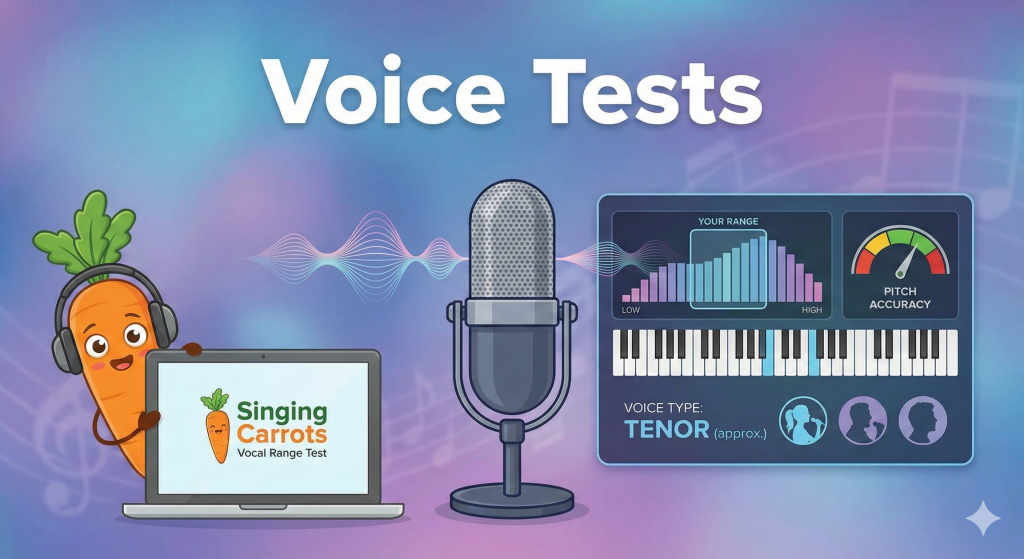
What exactly is a “voice test” in singing? In simple terms, a voice test is any assessment of your singing voice that evaluates key qualities like how high and low you can sing, how accurately you hit notes, and what kind of voice you have. Think of it as a check-up for your voice: you sing through some exercises or notes, and the test measures things like your vocal range, pitch accuracy, and voice type. Vocal coaches, choir directors, or even handy online tools can conduct voice tests. The goal is to help you understand your unique voice and its capabilities in an objective way, much like a fitness test gauges an athlete’s abilities.
What Does a Voice Test Measure?
A singing voice test typically checks a few core aspects of your voice:
- Vocal Range: Your vocal range is the span from the lowest note to the highest note you can comfortably sing. This is usually measured in terms of musical notes or octaves. For example, if your lowest note is C3 and your highest is C5, your range is C3–C5 (about two octaves). Vocal range is one of the most important metrics in a voice test – it describes the scope of sounds from low to high that your voice can produce. If you want to measure yours in practice, you can use an online vocal range test to find your lowest and highest notes in under a minute. Knowing your range helps you identify which songs or musical parts fit your voice. It’s also a baseline to track improvements; as you train, you might extend your range over time.
- Pitch Accuracy: A good voice test will also examine how well you can sing on pitch – in other words, hitting the correct notes without being flat or sharp. This is essentially a test of your ear and vocal control. Some specialized tests measure pitch accuracy very precisely, beyond just a teacher’s subjective listening. For instance, researchers have developed data-driven singing tests that assess how accurately you imitate target notes. In a voice test, you might be asked to match piano notes or sing simple melodies to see if you can stay in tune. Solid pitch accuracy means you can consistently center your voice on the intended notes (a crucial skill for any singer).
- Voice Type Classification: Based on your range (and sometimes other factors), a voice test can help identify your voice type – the general category your singing voice falls into. Voice types (especially in classical terminology) include soprano, mezzo-soprano, alto (contralto) for women, and tenor, baritone, bass for men. Essentially, your voice type is a classification based on where your most comfortable notes lie within your range. If a test finds you can sing very high notes with ease, you might be a soprano; if your voice sits naturally in lower notes, you could be a bass, etc. Many online vocal range tests will automatically suggest your likely voice type after measuring your range. Keep in mind this classification is a starting point – expert voice pedagogists note that true voice type is determined not just by range but also by tessitura (where your voice sounds best), timbre (vocal color), and register transitions. Nonetheless, a voice test’s type classification is a useful guide for singers, especially beginners, to understand which repertoire or role might suit them.
Modern online voice tests often visualize your vocal range and voice type. For example, some tools invite you to “test your vocal range” to find out how wide your range is, what your voice type might be, and even how you compare with famous singers. These interactive tests use your microphone to detect the lowest and highest notes you can sing, then give instant feedback on your range (in musical notes and octaves) and a voice type suggestion.
Beyond these main areas, certain comprehensive voice tests might measure additional attributes. For example, advanced voice assessment software can chart how loud or soft you can sing across your range (your dynamic range) and even analyze your vibrato – the slight pitch oscillation when you sustain a note. However, these detailed measures are more common in specialized or academic settings. Most singers, especially beginners, will focus on the big three (range, pitch, and voice type) since those give plenty of insight into one’s voice.
Voice Test vs. Vocal Range Test vs. Voice Type Test
It’s easy to get these terms mixed up, so let’s clarify:
- Voice Test: This is a broad term for any evaluation of your voice. A “voice test” could cover everything – your range, your pitch control, tone quality, and more. For instance, a choir director might do a quick voice test to hear your overall ability and decide where to place you in the choir. In a non-classical context, a basic voice test might simply involve some scales or a familiar tune to get a sense of what you can do. In short, “voice test” is an umbrella term for checking out your voice in general.
- Vocal Range Test: A vocal range test is a more specific type of voice test that focuses only on the range of notes you can sing. The aim is to determine your lowest comfortable note and your highest comfortable note. You usually perform a vocal range test by singing along to a piano or an app from low to high. The result might be given as notes (for example, E2 to G4) and the number of octaves that covers. Many online tools are specifically vocal range tests – they have you sing your bottom and top notes into a mic and then instantly calculate your range. This kind of test is very useful for finding out “How many notes can I sing?” and for choosing songs in keys that fit your voice. Remember, your range can evolve with training, so a range test is like a snapshot of where your voice is at a given time.
- Voice Type Test: A voice type test is typically aimed at pinpointing which voice category you belong to (soprano, alto, tenor, bass, etc.) based on your range and comfort zone. Essentially, it takes the range info a step further and labels it. For example, if a vocal range test finds you sing from C3 to C5, a voice type test might conclude you’re likely a Tenor (a common male voice type with that range). Many online “voice type” tests are really just vocal range tests with an algorithm that matches your range to the closest category. These tests provide a convenient starting point to answer “What voice type am I?”. However, be aware that true voice classification can be nuanced – vocal coaches often consider your tone and where your voice resonates best (tessitura) in addition to raw range. So, think of online voice type test results as an educated guess. They’re usually accurate enough for practical purposes (like helping you pick suitable song material), but a trained teacher or a thorough audition might assess your voice type in more depth.
- Pitch accuracy test. Where a range test maps the notes you can reach and a voice-type test labels your voice, a pitch accuracy test rates how well you actually hit notes. Precision, sustain, and whether you drift flat or sharp. It’s the one that answers “can I sing in tune?” rather than “what can I sing?” Try the free pitch accuracy test. It rates your singing in two minutes. Or read what an AI can and can’t judge about your voice [link: rate-my].
In practice, the terms voice test and vocal range test are often used interchangeably when people talk about testing their singing voice. If someone says “I took a voice test online,” they most likely mean a vocal range test that told them their range and perhaps their voice type. The main difference is that “voice test” can mean any kind of voice assessment, while a “vocal range test” zeroes in on range, and a “voice type test” specifically tries to classify your voice. For most casual singers, these tests overlap – you sing a bunch of notes, and you get both your range and an idea of your voice type from the same test.
Use Cases: Who Should Take a Voice Test and Why?
Why might you want to take a voice test? Here are some common scenarios where a voice test is useful:
- Beginners Curious About Their Voice: If you’re new to singing, a simple voice test can reveal a lot about your instrument. It will show you how low and high you can sing and give you a sense of where your voice is most comfortable. This is invaluable for beginners to avoid straining on songs that are out of their range. It’s also just fun and motivating to discover “Hey, I have a two-octave range!” or “I can hit that high note I never thought I could.” Knowing your range early on helps you pick songs that showcase your voice and sets a baseline to measure improvement. Many newcomers also love finding out which famous singer they share a range with (more on that in a bit!).
- Experienced Singers and Performers: For those already singing regularly, a voice test is a great tool for repertoire planning and self-improvement. Understanding your current vocal range and limits helps you choose songs in the right key and style. Knowing your range can guide you to songs that fit your voice perfectly – preventing the common mistake of forcing your voice into a song that sits too high or too low. Additionally, doing periodic vocal range tests can highlight progress from your training. Many singers see their upper range expand with practice, or their lower notes strengthen. Tracking these changes is encouraging and can inform your practice focus. As vocal coach Matt Ramsey notes, learning your range helps you find your voice type, identify weak spots, measure your vocal training progress, and pick the perfect songs for your voice. In a professional context, experienced singers even list their vocal range on resumes for musical auditions – it’s key info for casting directors and band leaders.
- Vocal Students in Training: If you’re taking voice lessons or part of a vocal program, your teacher will likely test your voice at the start and periodically thereafter. Regular voice tests act as a progress report for your voice. For instance, a student might start with a modest range and, after months of lessons, see that they’ve gained a few notes on the top or bottom. This quantifiable progress (“I increased my range by a whole step!”) is a great motivator. It also helps teachers adjust training – if a certain part of your range is still weak or unstable, they’ll know to work on that area. Moreover, identifying your voice type guides your training focus; a coach teaching a budding baritone versus a tenor will choose different song keys and exercise routines. In short, voice tests help ensure your practice is paying off and guide the next steps in your vocal development.
- Choir Members and Auditions: In choral settings, voice tests are essential for voice part placement. Choir directors often conduct a quick range test when new singers join. The aim is simple: to place each singer in the section where they can sing comfortably without struggling. For example, if your voice test shows you have a strong high range, you’ll be placed as a soprano or tenor; if you’re more comfortable low, you’ll go to the alto or bass section. This initial voice test in choirs is usually very straightforward and non-intimidating – you might be asked to sing “Happy Birthday” or follow a few scale patterns on piano. The director listens for where your voice sounds most resonant and at ease. All of this ensures you (and those around you) have a good experience singing parts that suit your voice. In auditions for musicals or choirs, knowing your vocal range ahead of time is also crucial – audition notices often specify required ranges for roles (e.g. “must belt up to F5”), so having tested your voice, you’ll know if you fit the bill.
- Hobbyists and Curious Minds: You don’t have to be a serious singer to take a voice test – it can be done just for fun or curiosity. A lot of people take online vocal range tests to see “What singer has a range like mine?” or to challenge themselves to hit that elusive high note. It’s become a bit of an internet trend for people to share their results (“I have the same range as Adele!”). Many modern vocal range tests add entertaining features: some will compare your range to famous singers and show you which celebrity’s range is closest to yours. For example, you might discover your range is similar to Taylor Swift’s or Ed Sheeran’s – a fun fact to know! This kind of gamified voice test can be really engaging for karaoke enthusiasts or anyone who wants to explore their voice. Plus, you might uncover hidden talents (maybe you actually have a wider range than you thought). Whether you sing in the shower or on stage, a quick voice test can be an enjoyable way to learn more about your voice.
A Great Tool to Test Your Voice: Singing Carrots’ Vocal Range Test
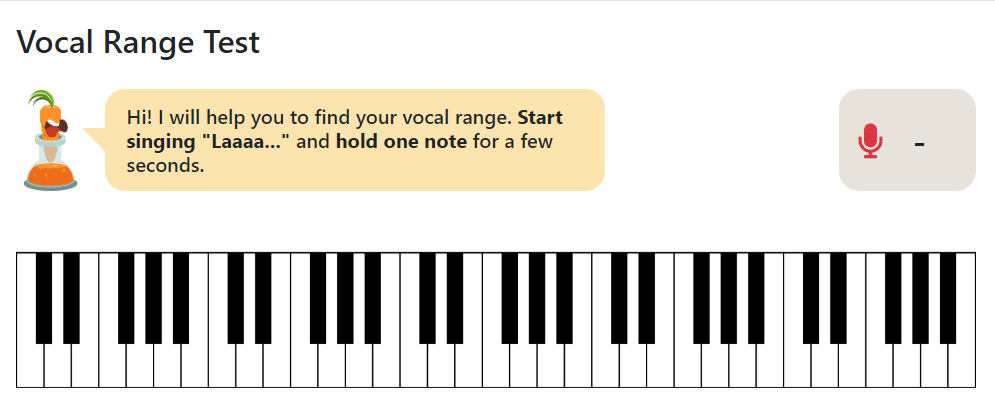
With so many reasons to try a voice test, how can you actually do it easily at home? One highly recommended option is to use an online vocal range test. A great example is the Singing Carrots vocal range test – an interactive tool that makes discovering your vocal range simple and fun.
Singing Carrots is a popular platform devoted to helping people improve their singing, and it turns voice training into an engaging game-like experience. Its vocal range test is at the heart of this experience. Here’s what makes the Singing Carrots range test stand out:
- Easy to Use: The test runs right in your web browser (on PC, Mac, or mobile – no special software needed). You don’t even need an instrument; just allow microphone access and follow the on-screen instructions. A friendly animated “singing carrot” character guides you through the process, telling you when to start singing. It asks you to sing and hold a note on an “laaa” or a comfortable vowel, starting at a note in your mid-range. Then it gradually prompts you to go lower and higher. The interface even visualizes the notes on a piano keyboard as you sing, so you can see in real-time which pitch you’re hitting.
- Accurate Range Measurement: Behind the scenes, the Singing Carrots test uses real-time pitch detection to pinpoint the exact notes you sing. Within seconds, it captures your lowest note and highest note with high accuracy. Once you’ve reached your limits, it calculates your full vocal range and displays the result on an intuitive keyboard graphic. You’ll see the note names for your low and high extremes, and the span in between. For example, it might show “Your vocal range is G2–B4.” It also tells you how wide that range is in terms of octaves and semitones.
- Voice Type and Singer Match: The Singing Carrots tool doesn’t stop at raw range numbers. It will determine your likely voice type based on the range you hit. If your range falls into a typical tenor span, it’ll identify you as a tenor; if it’s more like a mezzo-soprano, it will say so. This gives beginners a quick understanding of where they fit in the vocal spectrum. Additionally – and this is the fun part – the test compares your range to thousands of famous singers in their database. You’ll find out which famous vocalist you are closest to. Perhaps you have Mariah Carey’s low notes or share a similar range with Freddie Mercury! This feature is not only entertaining but also inspiring, as it puts your abilities in context with well-known voices.
- Tips and Warm-Up: The test is designed for all levels, but it wisely encourages good singing habits. When you start, it suggests that you warm up your voice for a better result (you can also skip this, but it’s a nice reminder that warmed-up vocal cords perform best). The interface provides a few quick warm-up exercises or you can do your own (simple humming or lip trills work great). By warming up, you’ll likely sing more accurately and possibly reach a bit further in range without strain – resulting in a truer measurement of your capabilities.
- Additional Tools and Learning: After using the range test, Singing Carrots offers more resources to support your singing journey. For instance, based on your voice type, they have a song finder tool that suggests songs suited to your range. If you’re a baritone who now knows your range, you can discover popular songs that fit comfortably in that range – no more struggling with songs that are meant for tenors or sopranos. Singing Carrots also provide a pitch accuracy test (to practice singing in tune) and various exercises. The platform essentially becomes your personal vocal coach, using the data from your voice test to tailor recommendations.
Perhaps the best part is that the Singing Carrots vocal range test (like many online tests) is completely free to use. You can take it as many times as you want. It’s a convenient, low-pressure way to get to know your voice. And because it feels a bit like a game, it’s actually fun – you might find yourself experimenting (“Can I hit a higher note if I try again after more warm-up?”).
In summary, a voice test is the starting point for any singer to understand their instrument. By measuring your range, checking your pitch accuracy, and identifying your voice type, you gather the essential facts about your voice. This information guides you in choosing suitable songs, finding the right vocal exercises, and setting realistic goals for improvement. Whether you’re a casual singer or an aspiring pro, taking a few minutes to test your vocal range can provide valuable insights and save you from a lot of trial-and-error. And with user-friendly tools like Singing Carrots’ range test readily available, you have an expert on your phone or in your browser ready to evaluate and celebrate your voice. So why not test your vocal range today and see what discoveries you make? Your voice might surprise you!
FAQ: Voice Test Basics
You can test your vocal range at home either using a piano (or keyboard) or an online range test tool. With a piano, start at middle C and sing “ah” while moving down step by step until you hit your lowest comfortable note. Then do the same moving up to find your highest note. The notes at those two extremes define your range. If you don’t have an instrument, try an online vocal range test – many are free. For example, the Tour de Fierce Vocal Range Test lets you sing your lowest and highest comfortable notes into your device’s mic, and it instantly calculates your range. This is a quick and easy method: just sing, and let the app tell you the result.
Yes, absolutely. Warming up is highly recommended before any voice test (or any singing, for that matter). A short warm-up (gentle humming, lip trills, or singing a few scales) will loosen up your vocal cords and improve your control. A warmed voice can reach its true lowest and highest notes more safely. In fact, some online tests actually remind or prompt you to warm up first for the best results. By warming up, you’ll avoid vocal strain and ensure the accuracy of the test – hitting notes cleanly that you might not reach when “cold.” Always remember: a voice test should never be about pushing until you hurt. If you feel strain, back off, rest, and try again after proper warm-ups or on a different day.
A basic voice test (especially online) will give you a good estimate of your voice type, but it’s not the final word. These tests usually match your measured range to the closest common voice category. So if your range is, say, G3 to G5, the test might output “Alto” or “Mezzo-Soprano” because that range overlaps with those types. This is a useful ballpark identification – many singers discover their likely category this way. For example, a range test will clearly distinguish a bass from a tenor. However, true voice type classification can be more nuanced. Professional voice coaches consider not just range, but also your tessitura (the range in which your voice feels and sounds best), your vocal timbre, and how your registers transition (your “passaggi”). In short, trust the test to give you an idea (and use that to pick suitable songs), but if you’re pursuing serious singing (like opera or solos), get a vocal coach’s opinion for a definitive voice type classification.
In many cases, yes – with training and healthy technique, singers can often increase their vocal range over time. Most untrained singers have a usable range of about an octave and a half to two octaves. With regular practice, exercises, and possibly guidance from a teacher, you might discover extra notes on either end. For example, you could strengthen your head voice to sing higher notes, or develop your chest voice to extend lower. It’s important to expand range safely: by improving breath support, vocal cord flexibility, and reducing tension.
Online voice tests are generally accurate enough for practical use, but there are a few caveats. The technology behind them (mic pitch detection) is quite advanced now – if you sing clearly into a decent microphone in a quiet room, the software can precisely identify the notes you hit. Many singers have found online tests to closely match the results of in-person assessments. That said, the accuracy depends on you doing the test under good conditions. To get the best results: use a quiet environment (background noise can confuse the pitch detector), use a good microphone (even your smartphone’s mic can work, just avoid distortion by not singing too loudly into it), and sing steady, sustained notes.