Updated October 2026
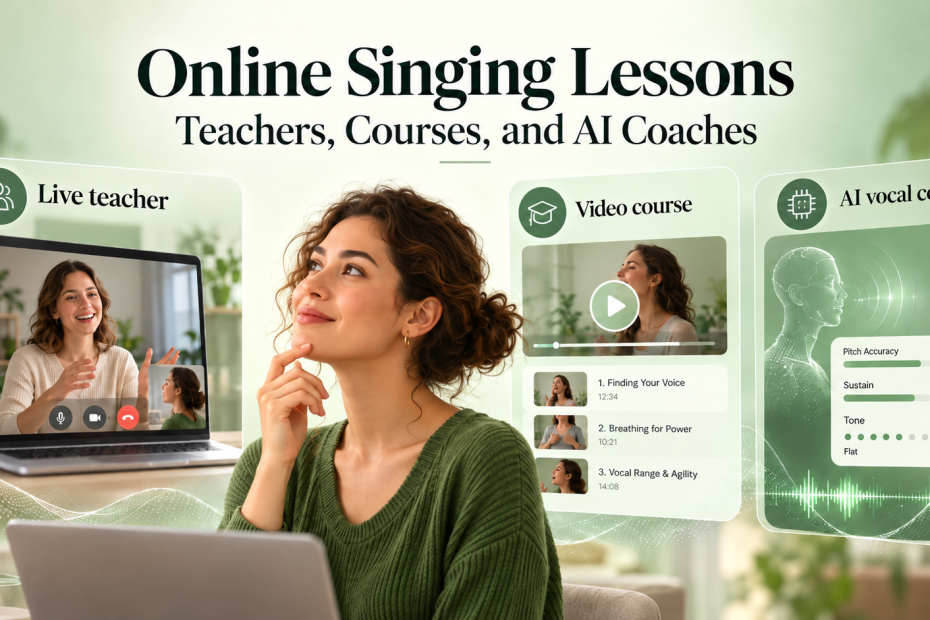
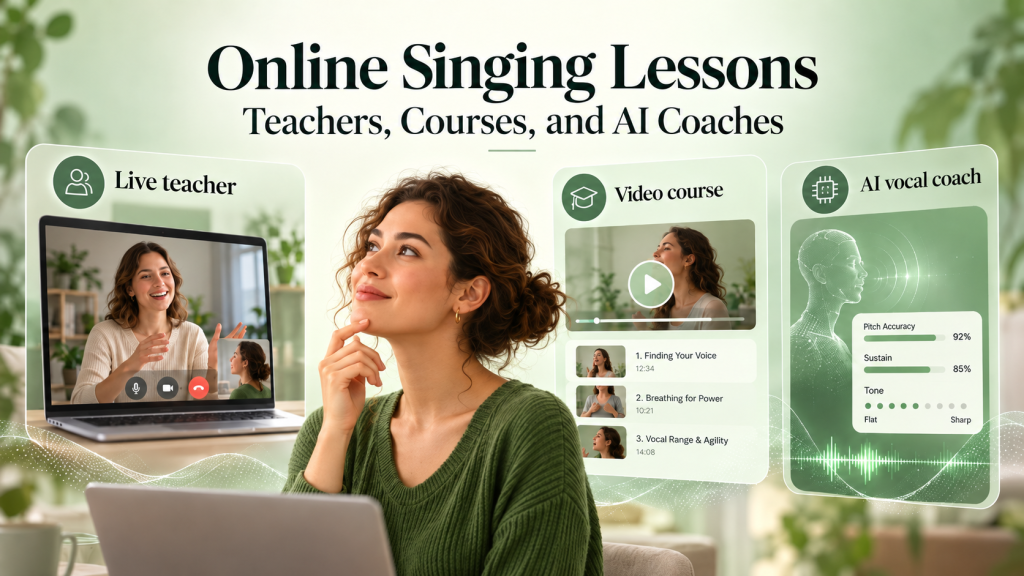
Online singing lessons come in three forms : a live teacher over video call, a self-paced video course, and — the newest — an AI vocal coach that listens to you sing and adapts each lesson to your voice. Which one fits depends on your bottleneck: a teacher if you need an expert ear on your technique, a course if you want structure at a fixed price, an AI coach if you want feedback every single day you practice. Costs run from about $10 a month to $80 and up per hour. One thing to know up front: we build the AI coach — so this guide names what each of the other options does better than ours.
Are online singing lessons worth it?
For most people, yes. On one condition: the format you pick has to close the feedback loop. Singing improves when you practice and find out what happened, note by note or habit by habit. While a teacher closes that loop with an expert ear once a week, an AI coach closes it instantly, every session. A course alone doesn’t close it at all. It only shows you what to do and leaves the checking to you, which is why courses work best paired with something that listens.
The improvement is measurable. Across 2,000+ singers on our platform, beginners gained 16.5 percentage points of pitch accuracy in their first four weeks, and the gains held at three months. That’s not unique magic of ours: visual pitch feedback is one of the best-evidenced tools in singing pedagogy, and the evidence on whether AI coaching works is nuanced about what can and can be accomplished.
When are online lessons not worth it? If singing causes you pain or strain, book an in-person teacher first. No screen can watch your posture or feel what your breath is doing. And if you won’t practice between sessions, no format survives that.
There’s also a more subtle advantage: at home, nobody is listening. Many beginners sing more freely without an audience in the room, and that comfort alone speeds up early progress.
Online or in-person singing lessons?
In-person lessons remain the gold standard for hands-on correction. A teacher in the room sees your posture from all angles, hears your true acoustics without internet compression, and can adjust your breathing on the spot. In-person studios also bring accountability. People practice more when a teacher expects them, and recitals and group classes build stage confidence no app provides.
What online formats win on is frequency. No travel means more sessions, and daily feedback between lessons is where most actual improvement happens. If you can access a good local teacher, that plus online practice tools is the strongest combination there is. If you can’t, online lessons with real feedback close most of the gap — and the rest of this guide maps those options.
What counts as online singing lessons: the three kinds
- A live teacher over video. Real lessons with a real person, scheduled, on Zoom for example. The first choice for technique problems and repertoire coaching.
- A structured video course. Pre-recorded lessons in a fixed sequence — 30 Day Singer is a well-known example . Affordable and well-produced. But these courses can’t hear you, obviously.
- An AI vocal coach. An app (web, iPhone, Android) that tests your range, builds each session around your level and goals, shows your pitch in real time while you sing, and adjusts the next lesson to what it heard. This is the newest category, and it’s the one we build.
What each costs
| Option | Typical cost | What you get |
|---|---|---|
| Live teacher Marketplaces like Lessonface, Preply | ~$20–$40 / half hour $40–$80+ / hour with experienced teachers | An expert ear on your singing, weekly; feedback on things no software hears |
| Video course 30 Day Singer | $100 to $200 | Structure and professional instruction at a fixed price; no feedback loop |
| AI vocal coach Singing Carrots | From $119.99 / year About $10 / month Free tools to start | Daily adaptive lessons with live pitch feedback; range test, pitch test, and pitch monitor are free |
Full course-by-course pricing, including one-time-purchase options, is in our singing course price comparison
We should add that hybrid models are also an option. For example, A hybrid of a structured video course and a live teacher over video. Online singing teachers have increasingly discovered this mode of working. An example is the Make Singing Click Club by Linor Oren. She has a structured video course, which she supplements with online group lessons in a masterclass format.
The live teacher: what only a human hears
A good teacher hears what caused the note, not just the note: the shallow breath, the tight jaw, the reach for a high note that should be a release. That diagnostic layer is the thing neither a course nor an AI coach replaces — we’ve written honestly about exactly where the line sits. Online marketplaces like Lessonface and Preply list voice teachers by price and review; Singing Carrots also hosts a directory of vocal teachers if you want lessons with a human alongside the tools.
Choose the live teacher first if something hurts when you sing, you’ve plateaued, or you’re preparing for a performance or audition. Or if you simply like human contact :)
The course: structure without a listener
Courses are the budget-friendly middle: a professional curriculum, good production, a fixed order that saves you from wondering what to practice next. Their structural limit is one-way video — whether you actually executed what the lesson taught rests on your own ear. If you learn well from structure, a course plus any tool that gives pitch feedback covers both halves. Our comparison of the major courses and what they cost.
The AI coach: lessons that adapt
This is the category we build, so judge the claims by the data linked above. The Singing Carrots AI Vocal Coach starts by measuring your range, then plans each session around your voice: warm-up, exercises picked for your level, real-time pitch display while you sing, and a coach that reviews each exercise and adjusts the next one. It keeps 91.5% of exercises inside your demonstrated comfortable range, and it remembers your progress between sessions. For beginners who want structure too, the coach runs a full four-week beginner course inside your sessions. It’s included with every membership, no separate charge.
The limits of our (and other) online courses: the coaching feedback is based on what you sang, not on watching you sing. It can’t see posture or feel breath support. And full coaching needs a paid membership, though the range test, pitch test, and pitch monitor are free.
Singing lessons app or a real teacher?
The short version: a teacher if you have strain, a plateau, or a date on the calendar; an app if you’re self-directed and want feedback every day; both if you can — the app between lessons is what makes the lessons stick. The full decision guide.
How to combine them: the hybrid week
The strongest setup we see in our data isn’t either-or. It’s a teacher once or twice a month for diagnosis and direction, and short daily sessions with feedback in between — 15–20 minutes, three times a week beats one long Saturday session. Here’s the practice ritual that works. Tell your teacher what the app’s data shows; tell the coach what your teacher said to focus on. The two get better together.
Depends on the kind: for live teaching, a well-reviewed teacher on a marketplace like Lessonface; for a structured course, 30 Day Singer is the best-known; for AI-coached lessons with live feedback, Singing Carrots. The three solve different problems — the guide above maps which is yours.
Yes, if the format gives you feedback and you practice between sessions. Beginners in our data gained 16.5 points of pitch accuracy in four weeks. Not worth it: learning through pain (see an in-person teacher) or buying structure you won’t use.
Yes — beginners improve fastest of any group in our data. Start by measuring your range and pitch free, then pick the format that fits. Our beginner’s guide.
Live teachers run by the hour, from roughly 40 dollars to 100+ dollars. Courses charge monthly or one-time. AI coaching is membership-based. Singing Carrots from $119.99/year with free tools to start. The cost table above has the details.