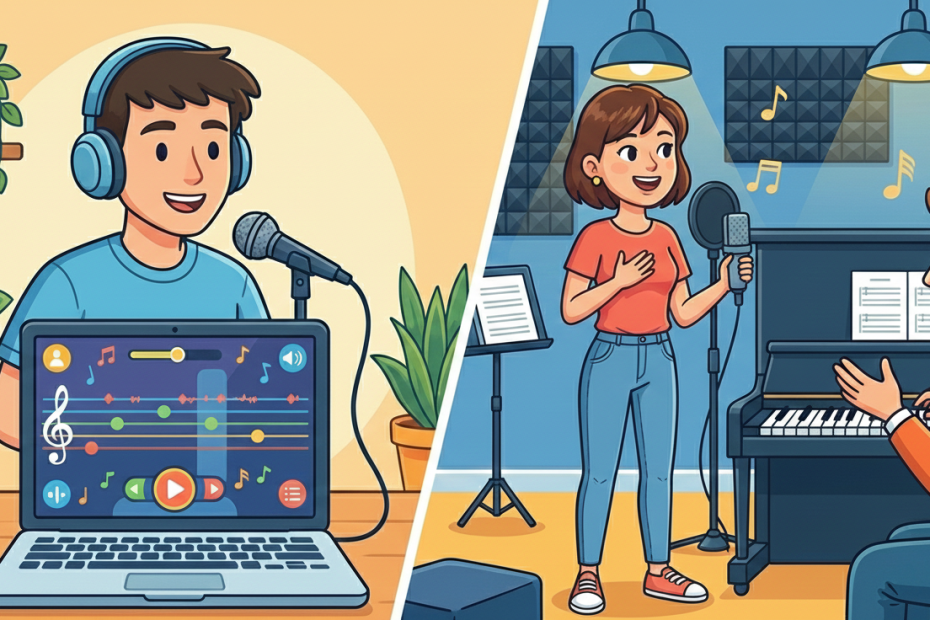

Learning to sing well depends on regular practice, good feedback, and the right motivation. Today’s singers can choose in-person voice lessons or online training platforms – each has strengths. Traditionally, singing teachers worked face-to-face, offering hands-on guidance. But modern technology has enabled highly interactive singing training online through lessons and practice tools.. The key question is whether one format leads to faster improvement than the other. In reality, progress depends on how often and how well you practice, but understanding each format’s advantages helps you decide. For example, apps and online platforms like Singing Carrots offer instant pitch feedback, progress tracking, and structured exercises that encourage frequent practice. By contrast, in-person coaches excel at noticing subtle technique issues and providing immediate, hands-on correction. Below we compare these approaches on key factors affecting improvement.
The Power of Consistent Practice
Across all learning formats, frequent, focused practice is crucial. Experts emphasize that short daily practice often beats occasional long sessions. For example, one voice school notes “practicing two hours once a week is much less useful than practicing 15 minutes every day”. Daily practice trains your vocal muscles and brain steadily. Online tools make it easy to fit practice into busy days, and they often track progress to keep you motivated. In fact, Singing Carrots reports that with just 20 minutes of practice per day, 80% of users see improvements in 2 weeks (90% in 4 weeks). With this consistency, they claim a 95% chance to expand your vocal range by two notes in five weeks. In short, whether lessons are in person or online, the frequency and quality of practice are what really drive improvement.
Strengths of In-Person Voice Lessons
In-person singing lessons have long been the gold standard for developing vocal skills. A live coach can observe you from all angles, providing immediate, physical guidance. For example, a teacher can see if you’re raising your shoulders or straining your neck, and correct your posture or breath support on the spot. This hands-on feedback helps students avoid forming bad habits. One vocal school notes that “live, focused attention leads to faster, more noticeable results” in students’ technique.
- Physical Correction: In person, teachers can model and adjust your posture, breathing, and mouth shape in real time, which can accelerate technical improvement.
- Acoustic Environment: Singing in a proper studio or performance space gives you the experience of real acoustics. Your coach hears your true voice (no internet compression), making it easier to fine-tune tone and resonance.
- Immediate Feedback: A face-to-face coach can provide instantaneous tactile or vocal demonstrations (e.g. playing piano to match your pitch), which is harder to replicate online.
- Motivating Environment: Being around peers and teachers at a music school or studio is inspiring. Many find that the commitment of showing up builds accountability and focus. In-person students tend to stick to schedules better, simply because they’ve committed time to a lesson. Schools also offer live recitals and group classes that build stage experience and confidence – factors that support faster growth in performance skills.
In summary, in-person lessons excel at nuance and discipline. They are often faster at correcting very subtle technique issues. However, this advantage comes at the cost of schedule and travel – you can only improve during lesson time (plus any assigned practice).
Advantages of Singing Training Online
Singing training online has transformed vocal learning with its flexibility and accessibility. Online lessons and apps have exploded in popularity, offering singers new ways to improve. Importantly, online training often encourages more frequent practice, because it’s easy and fun to sing at home. Platforms like Singing Carrots and live video lessons give many unique advantages:
- Convenience & Flexibility: You can learn anywhere there’s internet. No commuting means you can fit in more sessions or practice. Online lessons are usually cheaper and allow you to pick top coaches worldwide, not just locally. Busy professionals and students often improve faster when they don’t have to waste time traveling and can take lessons on their own schedule.
- Personalized Digital Tools: Many online platforms include interactive tools (pitch trackers, exercises, games). For instance, Singing Carrots provides instant visual feedback on pitch and statistics dashboards so you can monitor exactly how your intonation and range are improving. These tools give immediate correction (showing if you’re sharp or flat) and make practice engaging. Research suggests that seeing your progress and having structured exercises can accelerate learning.
- Comfort & Confidence: Learning from home can reduce performance anxiety. Beginners especially may sing more freely without an audience, which can speed initial progress. Studying online means that you can study with anyone, anywhere – broadening your options and making students more confident. Online lessons are “comfortable & beginner-friendly,” helping learners boost confidence.
- Recordings & Review: Most online lessons let you record sessions easily. You can replay your coach’s guidance as often as needed. This reinforces learning in ways a fleeting in-person demo cannot. Online students often practice right after seeing a note being held or turned a certain way, reinforcing technique immediately.
Many apps provide structured singing training online that adapts to your level. With regular practice, these platforms can deliver fast results – sometimes faster than sporadic in-person lessons.
What Helps You Improve Faster? Putting It Together
So which format leads to faster improvement? The answer often depends on the student. Key factors include how motivated you are, how much you practice outside lessons, and what kind of feedback you need. For many learners, a hybrid approach is best: combine the strengths of both worlds. For example, you might take occasional in-person lessons for specialized coaching (e.g. preparing for a big performance) while using online tools daily to reinforce skills.
- Commitment & Consistency: Whether online or offline, the fastest improvements come with regular practice. Tools like Singing Carrots help by “providing the space, guidance, real-time feedback, and motivation you need to keep practicing consistently – so you keep seeing results week after week.”.
- Quality of Feedback: If you need very detailed technical corrections (e.g. operatic technique, complex styles), in-person coaching might catch issues an app can’t. But online video technology (Zoom with high-fidelity audio, etc.) has reduced this gap significantly. Many teachers now use features like High Fidelity Audio Mode to get clear sound from student to coach.
- Personal Learning Style: Some singers thrive on face-to-face interaction and accountability. Others are self-driven and enjoy interactive apps or games that “feel like a game” (as one Singing Carrots user put it). Choose the format that keeps you engaged. You might even try both: many modern vocal students take a mix of in-person lessons, live online lessons, and daily app-based practice.
Ultimately, studies and experts agree that improvement speed is most tied to practice habits, not the medium. Consistently practicing even a little each day leads to steady gains. And the right feedback—whether from a teacher or a machine—guides you to improve faster. For example, Singing Carrots’ structured courses and exercises are designed so that “just 20 minutes a day, 2–3 times per week, is enough to start hearing real changes”.
Singing Carrots: An Example of Guided Online Practice
Singing Carrots exemplifies what modern singing training online can achieve. It offers gamified pitch exercises, video lessons, and a dashboard that tracks your range and intonation over time. By giving instant visual feedback on each note, it lets you correct yourself in the moment – much like an on-the-spot coach. The platform’s data shows that most users see quick results: “80% of our users see results in 2 weeks and 90% in 4 weeks” of regular practice. It even quantifies improvement: after five weeks (20 min/day), users had a 95% chance of expanding their range by two notes. These metrics underscore how disciplined practice with good tools can accelerate growth. Importantly, Singing Carrots also emphasizes theory and repertoire (searching songs by your range, building a setlist), so learners make holistic progress.
Of course, Singing Carrots itself notes that a human coach can “supercharge your progress”, but that real improvement comes from consistent practice – and a platform like this serves as a “vocal gym” when you’re not in lessons. In practice, many users find that combining a teacher’s guidance with daily app practice yields the fastest overall gains.
Conclusion
In the end, neither format is a magic bullet on its own – progress comes with effort. In-person lessons give invaluable personalized attention and can correct subtle issues quickly, which helps improvement. Singing training online offers flexibility, fun tools, and often lower cost, which tends to encourage frequent practice. As one guide puts it, “online tutoring can lead to a 30% faster improvement” in some cases thanks to personalization and convenience. What matters most is matching the method to your goals and sticking with it. If you can practice daily with quality feedback (from a coach or an app), you will improve faster than relying on rare lessons alone.
In summary: Practice consistently, use good feedback (digital or human), and stay motivated. Many singers today do best by taking occasional in-person lessons to nail technique, while using online tools and courses (like Singing Carrots) for daily practice. This hybrid strategy combines the strengths of both worlds, helping you see faster results and enjoy the journey to becoming a better singer.

Unleash 1 Million Voices – Singing Carrots Mission
Hi. I’m Sergey, founder of Singing Carrots. I’m on a mission to unleash one million voices. Bu…

What Makes a Good Singer? Linor Oren on Pitch, Tone, and Authenticity
Pitch, the most measurable part How much does pitch actually matter? “It matters, and I’…

The history of Singing Carrots
During the rainy Amsterdam winter of 2018, I was spending a lot of my evenings with my friends playi…

Is the Singing Carrots AI Vocal Coach worth it? An honest look
The Singing Carrots AI Vocal Coach is a strong fit if you’re a beginner or improving singer wh…
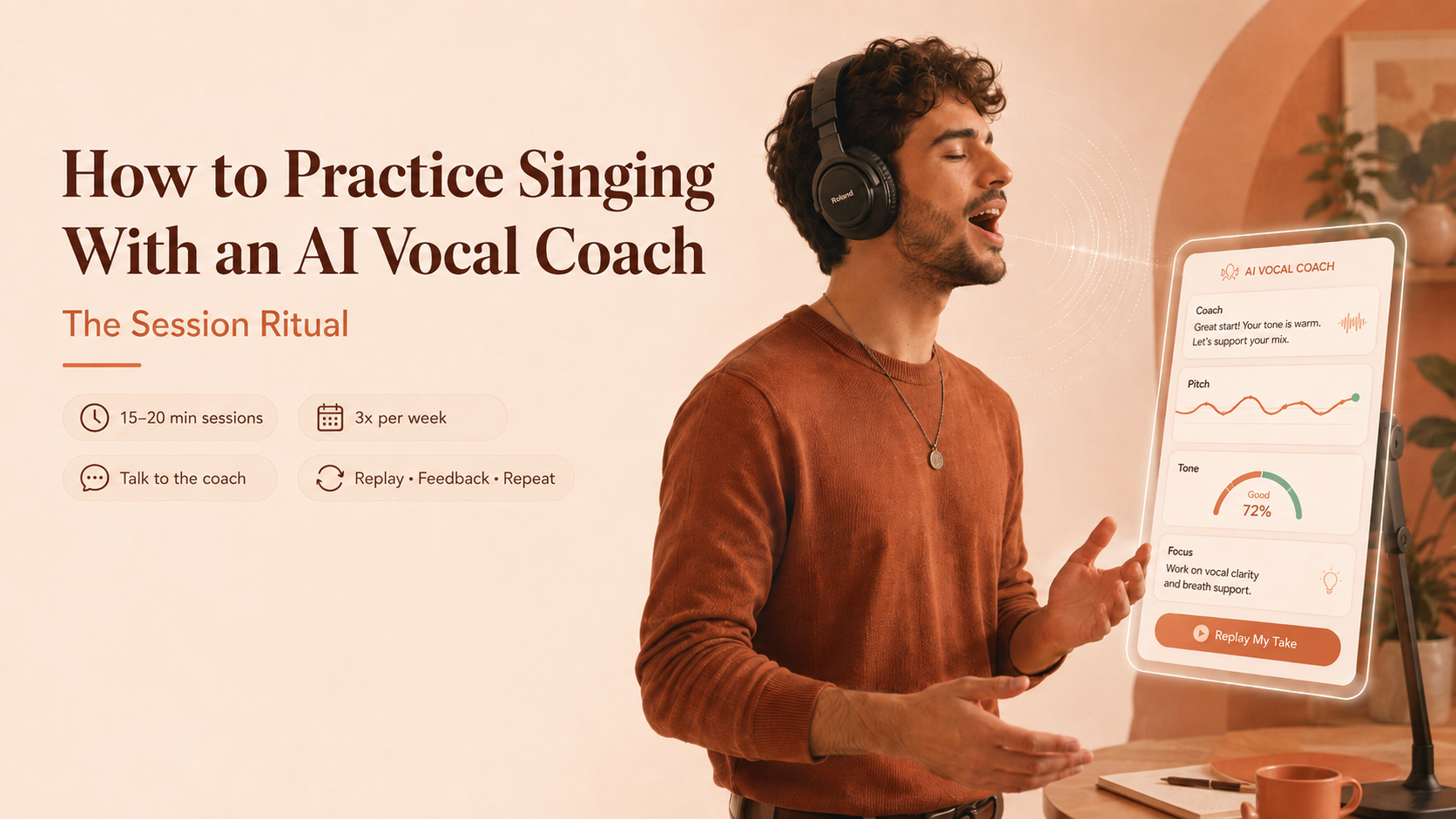
How to Practice Singing With an AI Vocal Coach: The Session Ritual
The short version: practice 15–20 minutes per session, three times a week — three short sessions bea…

AI That Sings for You vs. AI That Teaches You to Sing: The Difference
“AI singing” means two opposite things. AI voice generators (Suno, Udio, voice cloning) …
Can AI Replace a Vocal Coach? An Honest Answer From an AI Coach Builder
No. An AI vocal coach cannot replace a good human teacher (and we build one). A human hears nuance n…